
By Casey Lane, Intern at Kentucky Youth Advocates
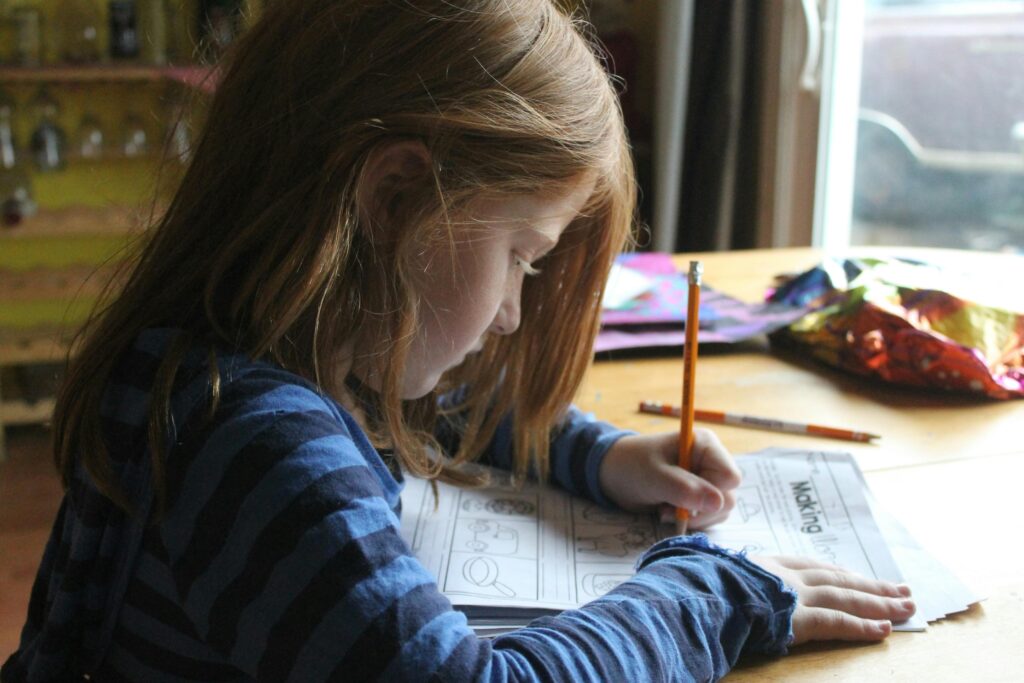 As homeschooling in Kentucky appears to be on the rise, let’s further explore some of the components of homeschooling, including strengths, concerns, and opportunities to improve homeschool practices in Kentucky.
Flexibility and Family Preference
Before and since the COVID-19 pandemic, parents have praised homeschooling’s flexibility, allowing families to travel and have a schedule that accommodates appointments, field trips, and other needs and preferences of the family. Homeschooling allows parents to customize their curriculum according to their faith, values, priorities, and to children’s interests and learning styles. Unlike the sometimes rigid structure of a traditional school day, homeschooling can allow a format that meets the unique needs of the individual child, with some parents incorporating learning into daily life experiences even outside of the home.
Homeschooling is not a uniform experience, as homeschool families can vary greatly in how they choose and structure their curriculum. Curricula packets or web-based instruction programs can be purchased, parents can create their own lesson plans, or some families choose to combine methods with tutors, “co-ops” or group meetings and lessons with other homeschool families, and some families may even include some formal instructor-lead classes.
The Kentucky’s Office of Education Accountability’s 2018 report on homeschooling in Kentucky cited religious preferences, concerns of children’s mental health, negative peer relationships, and parental disagreements with school decisions impacting their child (grades, discipline, etc.) as major recurring reasons families gave with the decision to homeschool. Especially with concerns of children’s mental health on the rise, some parents choose to explore homeschooling and find it to be a better fit for their families.
Attendance
The Kentucky’s Office of Education Accountability’s report also detailed how chronic absenteeism and truancy were the most common reasons for parents’ decision to homeschool, citing that one-third of students in 2017 who transferred from public school to homeschool were absent 20% or more of enrolled school days. The fear among many Directors of Pupil Personnel (DPPs) of the time was that some parents who switched to homeschool after truancy interventions began did not have the educational resources or environmental conditions in their homes to be conducive to learning, and would not be actually educating their child(ren), but instead using the homeschool laws to evade truancy interventions.
This fear of homeschool policy being used to mask educational neglect is not exclusive to DPPs regarding children facing truancy. Homeschool leading to educational neglect has been a growing concern for decades among some child welfare advocates, educators, and former homeschooled youth alike.
Accountability
The Kentucky legislature prescribes DPPs the responsibility to investigate if there are concerns of whether children are being educated in home schools and to enforce compulsory education attendance laws. Concerns may arise when a child is withdrawn from the public school system after chronic absenteeism or truancy, but otherwise, DPPs must largely rely on reports from mandated reporters, such as healthcare providers. DPPs’ other administrative duties within schools, as well as the time available to keep up with homeschool families, varies greatly from district to district.
The role of a DPP is very complex and current reporting systems do not make it easy for accountability or ensuring that kids are receiving an adequate education and are safe. However, nearly half of DPPs surveyed in 2018 expressed that they do not have the authority, in practice, to enforce education laws for home schools, citing Kentucky law does not provide clear guidance on the process that DPPs should use to determine if a child is being educated. Ultimately, the authority to enforce any consequences on home schools that are not educating falls onto the Department of Community Based Services (DCBS) and local courts. Local school district superintendents and DPPs can request attendance and scholarship reports (like grade records) from homeschool families, and report suspected educational neglect to DCBS to be further investigated. DPPs have also cited lack of clarity and specific guidelines in statutes pertaining to how homeschool records should be kept and assessed, as well as mixed-messaging as to what records DPPs have the authority to request, and when they should do so. In the 2018 report, DPPs and State officials with the Administrative Office of the Courts cited that DCBS is unlikely to investigate or file a claim of educational neglect unless other forms of abuse and neglect are suspected or present as well.
Kentucky’s statute defines educational neglect as when a “caretaker’s neglect prevents the child from attending school or receiving appropriate education.” But, short of instruction being required to be in the English language and some inclusion of reading, writing, spelling, grammar, history, mathematics, science, and civics, there is no guidance from Kentucky statute on what constitutes “appropriate” education.
Student Outcomes
The main way to measure academic performance of homeschooled youth is to compare their outcomes to their peers in public schools, yet there is a lack of data available to do so. Most states do not have standardized testing requirements for homeschool families or another way of measuring performance and outcomes, and Kentucky is no exception. The vast majority of research and data on homeschool academic performance has been funded and facilitated by homeschool advocacy organizations, which can create some bias and methodology issues.
Researchers have consistently found that homeschool students tend to do better in reading and English subjects but worse in math than public school peers, outperform or perform as well as their public-school cohorts on the SAT and ACT, and fare similarly or better in college. However, Kentucky’s Office of Education Accountability’s 2018 report suggests that homeschooled alumni attend Kentucky higher education institutions at less than half the rate as other Kentucky high school graduates.
Lack of objective and comprehensive data and research is a prevailing issue in the conversation of homeschooling and homeschool outcomes. Not without its own potential bias in sampling, a 2014 survey from an organization called Homeschool Alumni Reaching Out (HARO), in collaboration with the advocacy organization Coalition for Responsible Home Education (CRHE), is perhaps the largest scale study on homeschool alumni to-date, sampling over 3,000 adults who self-reported to have been homeschooled for at least 7 years. This survey found that homeschool alumni may follow similar patterns of educational and career attainment to the rest of the population when accounting for demographic factors, possibly corroborating the favorable studies from homeschool advocacy groups. Concerning, however, was that 51% of respondents reported experiencing abuse or neglect within their homeschool environment, with 17% of respondents reporting educational neglect or educational abuse.
Child Safety
As homeschools are not a monolith, the experiences of adults who were homeschooled vary greatly, with many expressing satisfaction and gratitude for the education their parents provided. However, recurring themes of abuse, extensive social isolation, and neglect, especially educational neglect and lack of preparedness for adulthood and the workforce, can be found throughout the testimonials of homeschool alumni in social media groups and forums like Reddit’s r/HomeschoolRecovery and the CRHE’s testimonials. Although child abuse and neglect is a horrific problem that is not exclusive to any particular setting of education, the isolated nature and lack of oversight of homeschooling allows abuse and neglect to thrive, including child labor and child sex-trafficking. The CRHE reports that in 2016, an unnamed Kentucky county attorney cross-referenced homeschooled students of his school district with court records, and found that 30% of the homeschools were the subject of a past child welfare report.
With the nature of homeschooling, children are even less likely to have contact with professionals or even other adults outside the home that could report suspected abuse, likely leading to a misrepresentation of reality in the data. The CRHE maintains tracking of publicly available abuse and child fatality cases that feature homeschooling with an initiative called Homeschooling’s Invisible Children, Continuing to look at the intersection of child abuse and neglect and homeschooling will only strengthen child safety and student outcomes that all parents and decision makers strive for in discussions around homeschool in Kentucky.
This blog post is part of a series on issues surrounding homeschooling in Kentucky, including the benefits, concerns, as well as discuss some recommendations that can promote responsible homeschooling, protect homeschooled children, and empower current or future homeschool alumni.
Photo by Jena Backus via Pexels



I have a soon to be 11 year old great nephew who has supposedly being “homeschooled” by his mother. If he is functioning at a 1st grade level I would be surprised. I’ve have been aware of this since he was supposed to be in 1st grade. I have called Hardin County schools and the Dept of Ed for KY. I was told that there was no reason to open an investigation. Ontop of this his is lacking in social skills, no friends, no outside activities, no sports, no interaction with children of his age.I am very concerned.