

Data from the U.S. Census Bureau serves as a critical source of information for understanding Kentucky’s child population, family income levels, young adults working or in school, among other data. The Census Bureau gathers data through tools like the Decennial Census, which counts everyone living in the U.S. every 10 years, and other surveys like the American Community Survey.
Census data informs funding for important programs for Kentucky children

National School Lunch Program
National School Lunch Program
486,970 Kentucky students participated in the National School Lunch Program

Title I Programs for Schools
Title I Programs for Schools
459,054 Kentucky students participated in Title I programs for schools with high levels of students in low-income families

Child Care Assistance for Families
Child Care Assistance for Families
Families of 51,350 Kentucky children received assistance in paying for child care

Children’s Health Insurance Program
Children’s Health Insurance Program
132,000 Kentucky children accessed health care through the Children’s Health Insurance Program (CHIP)
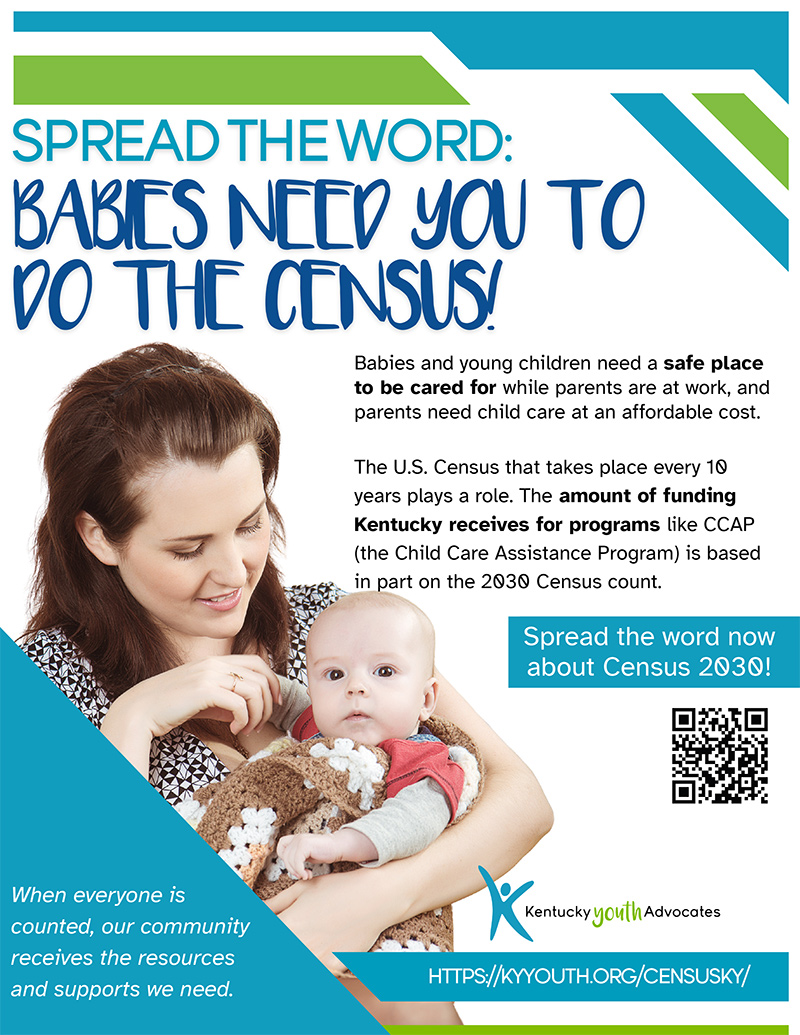

Featured News









Spread the Word
Insights on Kentucky’s Children and Families from U.S. Census Bureau Data by Congressional District
Census 2030 is coming, and a complete count of people in our communities will help ensure Kentucky receives the resources our communities and children need to thrive.
Data to Dollars : Federal funding for Kentucky impacted by US Census data (PDF)
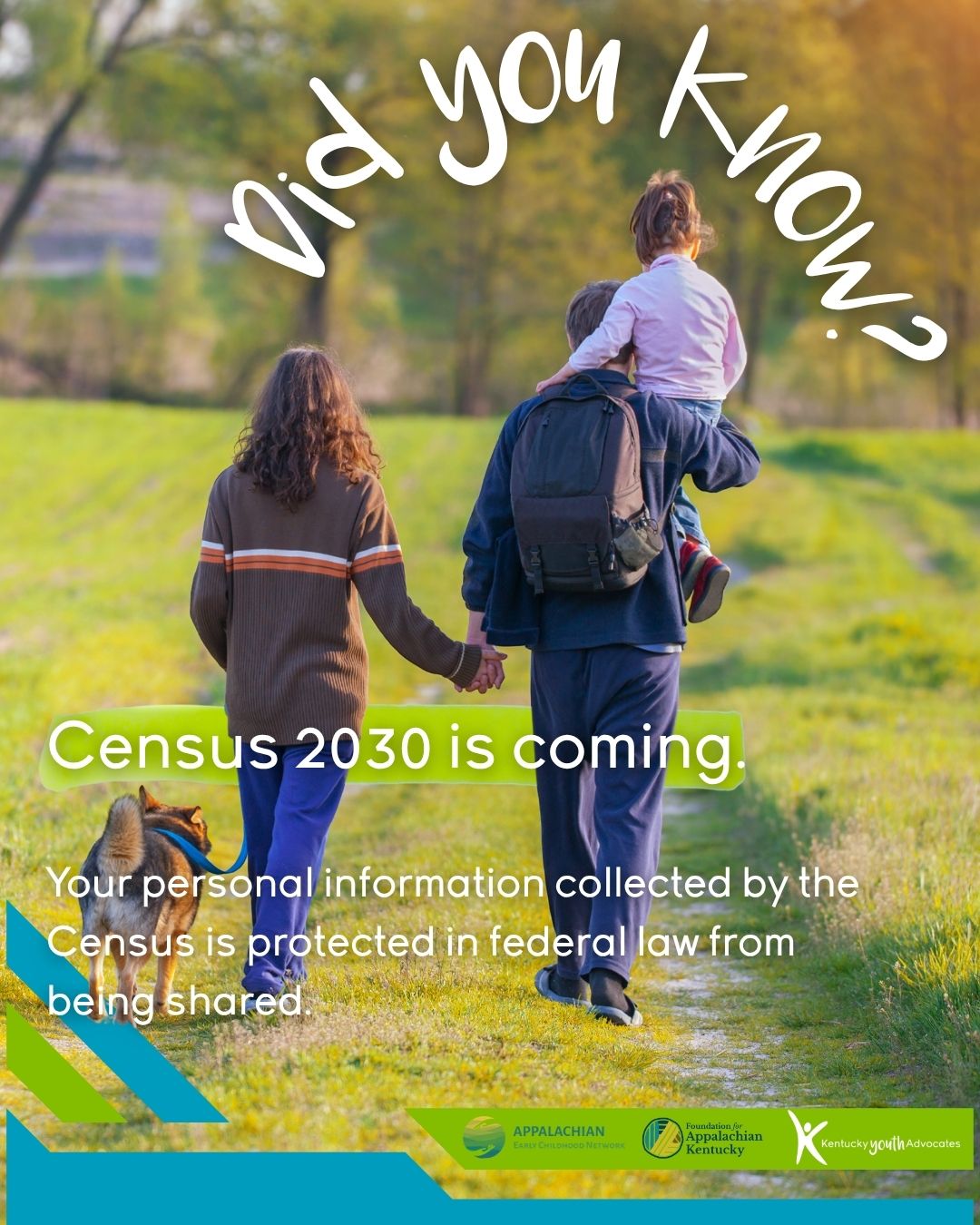
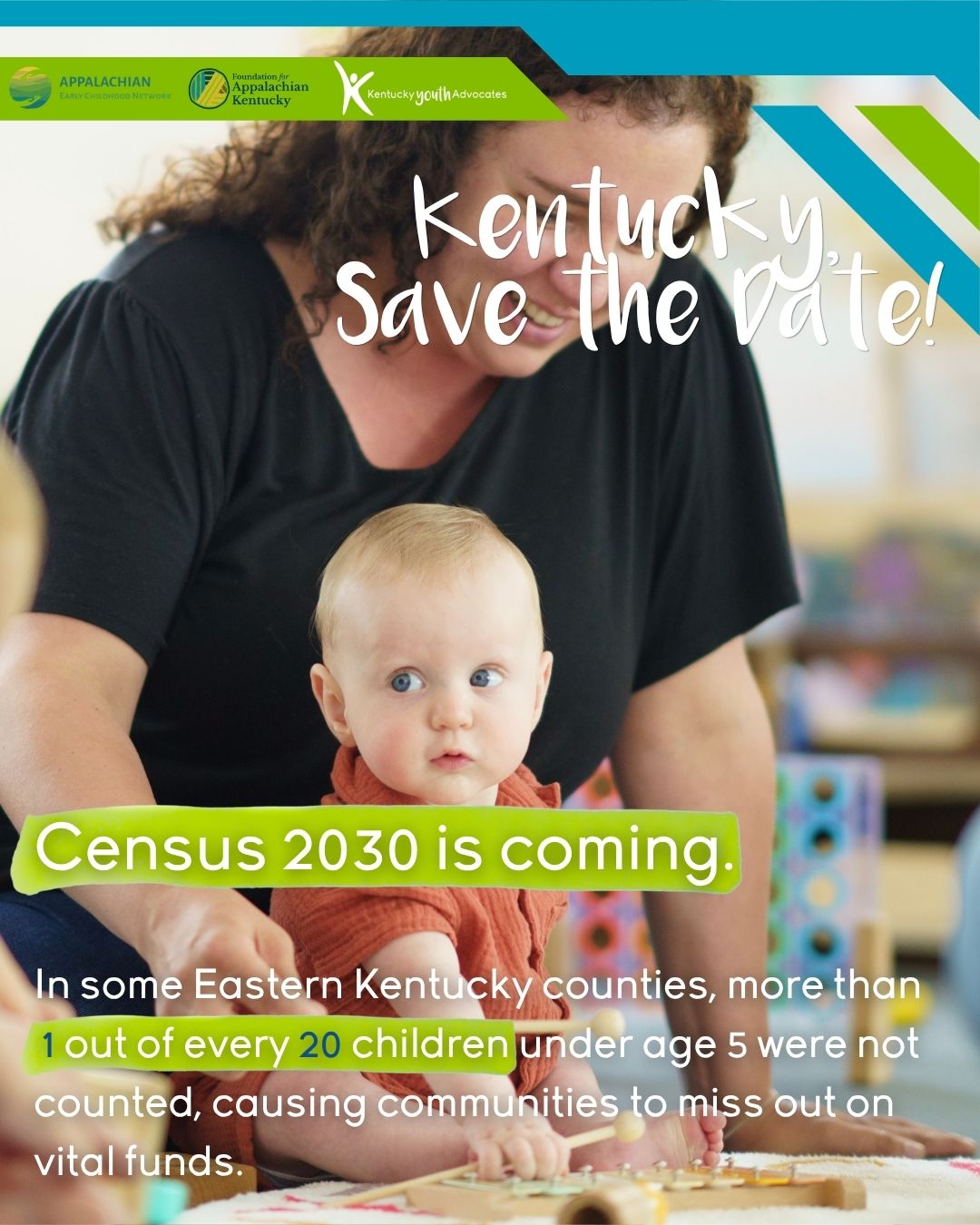
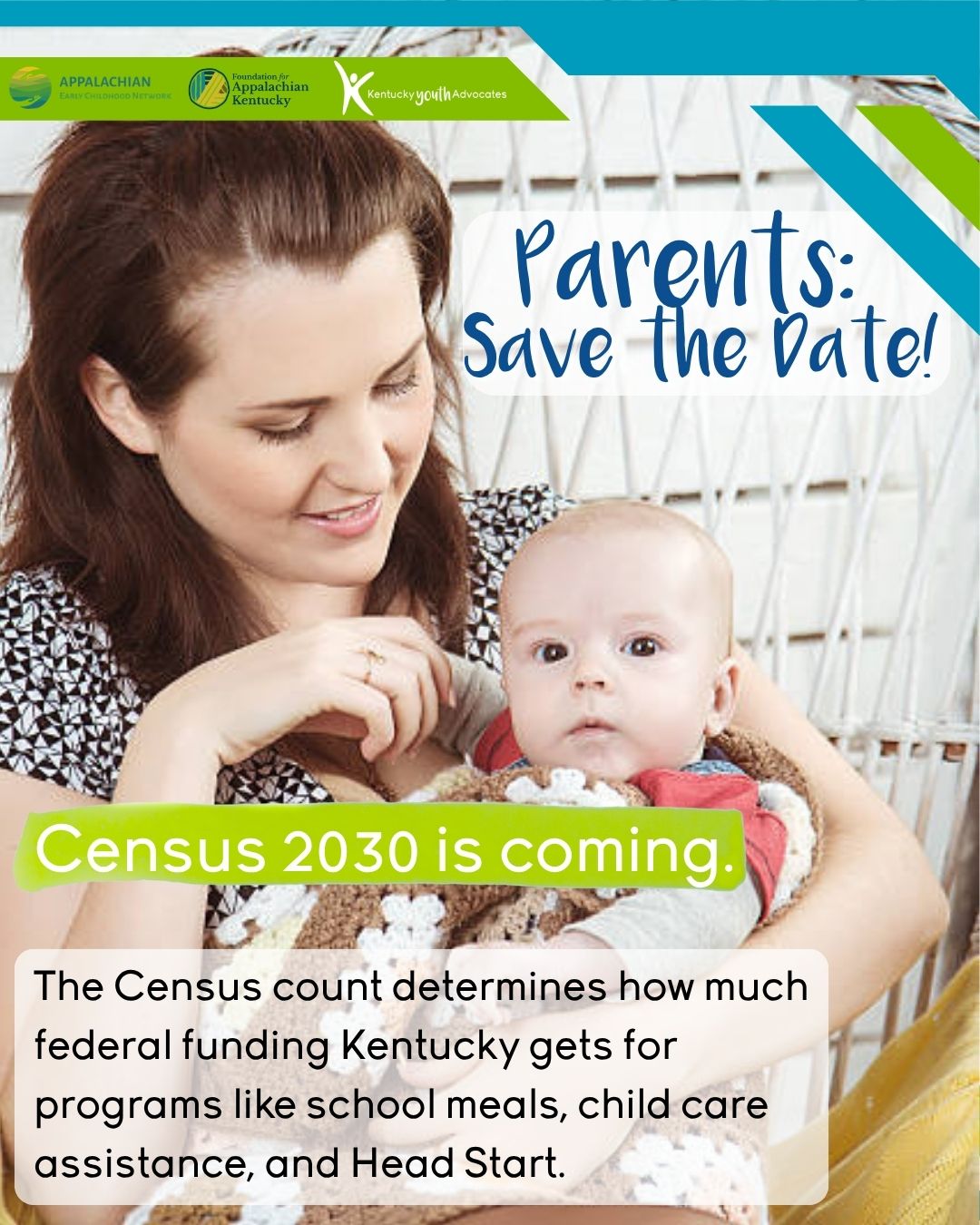
Help spread the word about Census 2030! Please share these social media graphics on your social media accounts to help let your friends and colleagues know how important it is to get a complete count for Kentucky communities.
Advocate
The Census Bureau does more than just a headcount—it holds powerful data that tells the story of how Kentucky communities are doing, shapes how federal funding is allocated, decides Congressional representation, and guides community resources and planning. Decisions being made now will impact the quality of the 2030 Census and the vital data collected. Use this toolkit to educate policymakers and people in your community about the steps we can take to ensure the Census Bureau has what it needs to get us the data, resources, and representation we need.
Are you:
An elected official?
A community leader?
A nonprofit employee?
A small business owner or corporate executive?
An educator?
A social worker?
A healthcare worker?
A voter?
An advocate?
If you answered yes to any of these, then you likely rely on data put out by the U.S. Census Bureau to understand the needs of your community, plan how to allocate resources, identify problems, receive federal funding, or know what Congressional District you belong to. This is especially true for community leaders and organizations in rural counties, as the Census Bureau is the only consistent source of data for many small geographic areas.
Purpose of the Census
The Decennial Census is required by the Constitution, included by the founders to ensure that an accurate count of the country’s entire population was collected every ten years. It was initially designed to ensure accurate Congressional representation, but has evolved to support and direct the distribution of federal funds to communities across the country. The Census is now housed within the Census Bureau, which is the leading source of high-quality data on America’s people and economy.
Census and Congress
Congress is responsible for overseeing and allocating funds to the Census Bureau. It is vital that advocates and Census users emphasize the importance of Census data to their Congressional members and help build Congressional support.
There are several committees in Congress that oversee and fund the Census Bureau:
- The House and Senate Appropriations Committees recommend how much funding the Census Bureau and other agencies should get each year. Both Appropriations Committees have a subcommittee – the Commerce, Justice, Science Appropriations Subcommittee – that is primarily responsible for all funding needs related to the Census.
- The House Oversight and Government Reform Committee oversees the operations of and considers legislation related to the Census Bureau for the House of Representatives. Legislation must go through this committee before it can be voted on by the full U.S. House.
- The Senate Homeland Security and Governmental Affairs Committee oversees the operations of and considers legislation related to the Census Bureau for the Senate. This committee has a subcommittee – called the Subcommittee on Disaster Management, District of Columbia, and Census – that is primarily responsible for all issues related to the Census. Legislation must go through this committee before it can be voted on by the full U.S. Senate.
Members of Kentucky’s Congressional delegation lead many of the committees that govern the Census:
- Senator Rand Paul is the Chair of the Senate Homeland Security and Governmental Affairs Committee.
- Representative James Comer (KY-1) is the Chair of the House Oversight and Government Reform Committee.
- Representative Hal Rogers (KY-5) is the Chair of the House Commerce, Justice, Science Appropriations Subcommittee.
Committee Chairs choose what topics committees focus on, convene hearings on issues, and ultimately decide what bills the committee will take action on. With Kentucky’s Congressional Members leading many of the committees that touch the Census, Kentucky plays a key role in deciding how the Census Bureau operates.
Census Bureau Advocacy Needs
Administering a survey to and publishing data for the entire U.S. population is expensive and time-consuming. For example, planning for the 2030 Census began in 2019 and will not be complete until 2033.
To ensure the Census Bureau can plan for 2030 and publish high-quality data for all Kentucky communities, the agency needs:
- Adequate funding. This is especially important right now as the Census Bureau begins planning for the 2030 decennial Census. However, Congress has not increased the Census Bureau’s budget in the last two years.
- Public support. The Census Bureau collects a lot of sensitive data, and survey takers need to know that the Bureau will keep their responses safe. It is essential that the Census Bureau remains a neutral, nonpartisan source of information with strong safeguards in place to protect the privacy of all participants.
Ways to Advocate for the Census
Community leaders, organizations, and advocates play a key role in informing Congress on the importance of the Census to their community. Some ways you can advocate for the Census in Congress include:
- Schedule a meeting with your U.S. Representative and Senators. In this meeting, you can talk about the importance of the Census, share how Census data impacts your work and community, and encourage them to fully fund the Census and maintain its nonpartisan, independent status.
- NOTE: You can schedule meetings with your Member of Congress in person at their D.C. or district offices, via Zoom, or via a conference call.
- Call, email, or write a letter to your U.S. Representative and Senators. Members of Congress are more likely to reply to short communications that are delivered in a neutral tone and have clear requests.
- NOTE: It may take several weeks for a Member of Congress to get your letter, as they must go through a strict screening process.
Additionally, you can advocate for the Census within your community and start planning for 2030 by:
- Educating your community about the Census. Utilize Census data in your work, discuss the Census with your neighbors, and host events that explain what the Census is and why it matters.
- Forming a Complete Count Committee for your community or county. A Complete Count Committee is a coalition made up of local leaders, faith-based and community organizations, and government agencies that work to increase awareness, identify and plan to engage hard-to-reach groups, and organize activities that encourage Census participation. View information on the 2020 Census Complete Count Committees here.
- Encouraging your local government to participate in the Local Update of Census Addresses (LUCA). LUCA is the process where local governments review the list of addresses the Census Bureau will use to send out the 2030 Census, delete addresses that no longer exist, and add addresses that are missing. LUCA will start in 2027, and now is the time to talk to your local leaders about planning for this update.
Contacting your Members of Congress
You can find who your House Representative is at house.gov, and you can contact your Representative by calling or writing to the following:
Representative James Comer (KY-1)
- Washington DC:
-
- Address: 2401 Rayburn House Office Building, Washington, D.C. 20515
- Phone: (202) 225-3115
- Madisonville Office:
- Address: 67 North Main Street, Madisonville, KY 42431
- Phone: (270) 487-9509
Representative Brett Guthrie (KY-2)
- Washington DC:
- Address: 2161 Rayburn House Office Building, Washington, D.C. 20515
- Phone: (202) 225-3501
- Bowling Green Office
- Address: 996 Wilkinson Trace, Suite B2, Bowling Green, KY 42103
- Phone: (270) 842-9896
- Fax: (270) 842-9081
Representative Morgan McGarvey (KY-3):
- Washington DC:
- Address: 1527 Longworth House Office Building, Washington, D.C. 20515
- Phone: (202) 225-5401
- Louisville Office:
- Address: 600 Dr Martin Luther King Jr Pl, Louisville, KY 40202
- Phone: (502) 582-5129
Representative Thomas Massie (KY-4)
- Washington DC:
- Address: 2371 Rayburn House Office Building, Washington, D.C. 20515
- Phone: (202) 225-3465
- Northern Kentucky Office:
- Address: 541 Buttermilk Pike, Suite 208, Crescent Springs, KY 41017
- Phone: (859) 426-0080
- Fax
Representative Hal Rogers (KY-5)
- Washington DC:
- Address: 2406 Rayburn House Office Building, Washington, D.C. 20515
- Phone: (202) 225-34601
- Hazard Office:
- Address: 48 S. KY Hwy. 15, Hazard, KY 41701
- Phone: (606) 439-0794
- Fax: (606) 439-4647
Representative Andy Barr (KY-6)
- Washington DC:
- Address: 2430 Rayburn House Office Building, Washington, D.C. 20515
- Phone: (202) 225-4706
- Lexington District Office
- Address: 2709 Old Rosebud Rd., Ste. 100, Lexington, KY 40509
- Phone: (859) 219-1366
- Fax
You can contact your Senators by calling or writing to the following:
- Washington DC:
- Address: 317 Russell Senate House Office Building, Washington, D.C. 20510
- Phone: (202) 224-2499
- Lexington Office:
- Address: 771 Corporate Drive, Suite 108, Lexington, KY 40503
- Phone: (859) 224-8286
- Fax
- Washington DC:
- Address: 295 Russell Senate Office Building, Washington, D.C. 20510
- Phone: (202) 224-4343
- Bowling Green Office
- Address: 563 Hub Boulevard, Suite 201, Bowling Green, KY 42103
- Phone: (270) 782-8303
Email: paul_schedule@paul.senate.gov or https://www.paul.senate.gov/connect/
1. What is the U.S. Census Bureau?
The U.S. Census Bureau is a government agency responsible for collecting, compiling, and disseminating data about the population and economy of the United States. It conducts the decennial census and other surveys that provide vital statistics used for policy, planning, and decision-making.
2. What is the Census Bureau known for?
The Census Bureau is most known for conducting the decennial U.S. Census, a national count of every person living in the United States. This count happens every 10 years and determines how hundreds of trillions of dollars in federal funds are allocated to every state, as well as how political representation is distributed across the states.
3. Does the Census Bureau conduct surveys other than the decennial Census?
Yes! In addition to the decennial Census, the Census Bureau conducts dozens of other surveys, including:
- American Community Survey (ACS): An ongoing survey that provides detailed demographic, social, economic, and housing data. This data provides the most complete picture of how Americans in every community–from large cities like Louisville to small towns like Scottsville–are doing and living.
- Current Population Survey (CPS): A monthly survey focused on labor force statistics, employment, and unemployment rates. This survey is used to provide population estimates for every community in the 10 years between each decennial Census.
- Economic Census: A survey of U.S. businesses and industries that is conducted every five years.
- Geographic programs: The Census Bureau provides and maintains geographic information and mapping services to support all its surveys and data collection efforts.
4. What types of data does the Census Bureau collect?
The Census Bureau collects data on a variety of topics, including:
- Demographics: Age, sex, race, ethnicity, family structure, and household size.
- Housing: Information about homeownership, rental status, utility access, and types of housing units.
- Economic data: Employment, income, industry sectors, business activity, and poverty rates.
- Social data: Education, disability status, marital status, kinship care, and other aspects of daily life.
5. What is Census data used for?
The Census Bureau’s data is used in many ways, including:
- Deciding the make-up of Congress: The Census determines the number of U.S. House of Representatives seats each state receives, as well as to decide the boundaries of legislative districts.
- Distributing federal funds: Census data helps allocate trillions of dollars in federal funds to state and local governments for programs like healthcare, transportation, education, and public services.
- Planning and research: Federal, state, and local governments, businesses, researchers, and nonprofit organizations use Census data to make informed decisions about infrastructure, services, and policies. For example, much of the data used by the KIDS COUNT project comes from the U.S. Census.
- Disaster planning and response: Census data is used to create disaster plans so communities can be prepared for the worst, as well as to ensure that disaster aid is appropriately distributed to households.
6. What geographies (i.e., state, county, neighborhood, etc.) does the Census Bureau provide data on?
The Census Bureau provides a wide range of geographic data, including:
- Census tracts and blocks: Detailed geographic boundaries for neighborhoods, cities, and counties.
- Mapping tools: Interactive maps and geographic tools for planning and research.
7. How does the Census Bureau gather data?
The Census Bureau uses a variety of methods to gather data, including:
- Surveys: People can respond to Census surveys online, by phone, or by mail.
- In-person: During the decennial Census, Census Bureau employees visit homes in person to follow up with non-respondents or collect data from people in hard-to-reach areas.
- Administrative records: The Bureau may use data from other government sources, such as tax and public benefit records, to supplement census data.
8. How does the Census Bureau protect the privacy of respondents?
The Census Bureau currently has strong privacy protections in place, and Title 13 of US Code requires that all individual responses to Census surveys are kept private. The Census Bureau cannot release your personal data to anyone, including other government agencies and law enforcement. All data shared by the Census Bureau is aggregated in a way that ensures your individual answers to questions cannot be traced back to you.
9. How do I know if the survey or caller is legitimate?
For someone visiting your home, they should have a valid US Census Bureau ID badge. If you are still unsure, you can contact your Regional Office to verify that the person is a Census employee. For email, if it seems suspicious, do not click any links and forward it to ois.fraud.reporting@census.gov, and the Census will investigate and notify you of the findings.
Any surveys from the Census will have a return address from Jeffersonville, Indiana. If you have questions about whether a mailed survey or someone calling you to complete a survey is legitimate, you can contact the National Processing Center to verify their status.
10. Where can I find Census Bureau data?
The Census Bureau offers data products and tools that allow users to customize reports based on specific variables (such as age, race, or income) and geographic areas (like cities, counties, or states). The American FactFinder and data.census.gov are platforms where users can search for and access specific datasets.
11. Who should fill out Census Bureau surveys?
Census surveys such as the American Community Survey are sent to a random sampling of US addresses, while the decennial Census (which will happen in 2030) is sent to every address in the US. If you received a Census Bureau survey in the mail, you are legally required to fill it out. One member of the household should fill out the survey on behalf of the entire household, including children, other family members, and roommates.
Census data is used to decide how over a trillion dollars worth of federal funds are spent, plan for natural disasters and economic development, and paint an overall picture of how Kentuckians (and Americans) are doing. Below are sample talking points you can use in Congressional meetings to highlight how vital Census data is for you and your community.
Note – When using these talking points, we encourage you to incorporate:
- Examples of how you have used Census data in your work and community
- Stories of how you have benefited from programs whose funding relies on Census data
- Census data for your Congressional District
You can find Census data for all six Congressional Districts in the Congressional Data Sheets on this webpage and at data.census.gov.
Economic Development & Infrastructure
- Kentucky has a higher-than-average poverty rate, and targeted investments are needed to address persistent poverty.
- Census data helps communities address poverty by directing federal funding and resources to job creation programs, workforce development, and broadband expansion, all critical for attracting businesses and economic opportunities to Kentucky.
- Accurate Census counts support funding for roads, bridges, and public transportation, which are vital for a region with difficult terrain and dispersed communities.
- Census data also supports planning for community infrastructure, like schools, hospitals, and post offices, ensuring that residents have access to needed services.
Food Insecurity & Public Assistance
- One in five Kentucky kids experience food insecurity. Families across Kentucky rely on federal nutrition assistance programs like WIC, school meals, and food bank programs to keep their children from going hungry.
- Census data determines the level of funding these programs receive. An undercount could mean thousands of families missing out on vital food resources.
- Nonprofits and food banks throughout Kentucky rely on Census-driven data to identify need and distribute resources effectively, ensuring no family is left behind.
Kinship Care & Support for Grandfamilies
- Kentucky has a high rate of residents who provide kinship care. Many grandparents and relatives are raising children informally, and they don’t have access to the same financial or legal support as traditional foster care families.
- Given that kinship care in Kentucky is often informal, the annual American Community Survey is the only source of data that counts all kinship caregivers.
- Census data helps secure funding for programs that support kinship caregivers, such as Medicaid, child care subsidies, and Temporary Assistance for Needy Families (TANF), known as K-TAP in Kentucky.
- Without a complete count of Kentucky’s population, many kinship caregivers remain invisible in the data, making it harder to advocate for policies and target resources that support them.
Natural Disaster Preparedness & Recovery
- Kentucky has experienced severe natural disasters in recent years, devastating entire communities. Census data informs disaster preparedness plans and determines federal emergency relief funding. An undercount means fewer resources for rebuilding and protecting at-risk areas.
- Data from the Census and the American Community Survey (ACS) helps emergency responders identify the most vulnerable populations, including elderly residents and those with disabilities, ensuring they receive assistance first during a crisis.
Geographic Barriers & Undercount Risk
- Many Kentucky households, especially those in rural areas and the Appalachian region, lack a physical street address or rely on P.O. boxes. These households are more likely to be missed in the Census, which can impact every aspect of a community, from healthcare funding to school district planning.
- The Census Bureau needs adequate funding to engage with trusted local organizations, faith communities, and schools to ensure every person in every household is counted, regardless of how remote or hard they are to reach.
Carousel 1: Economic Security
Has the percentage of children experiencing poverty in Kentucky increased or decreased in the past 5 years?
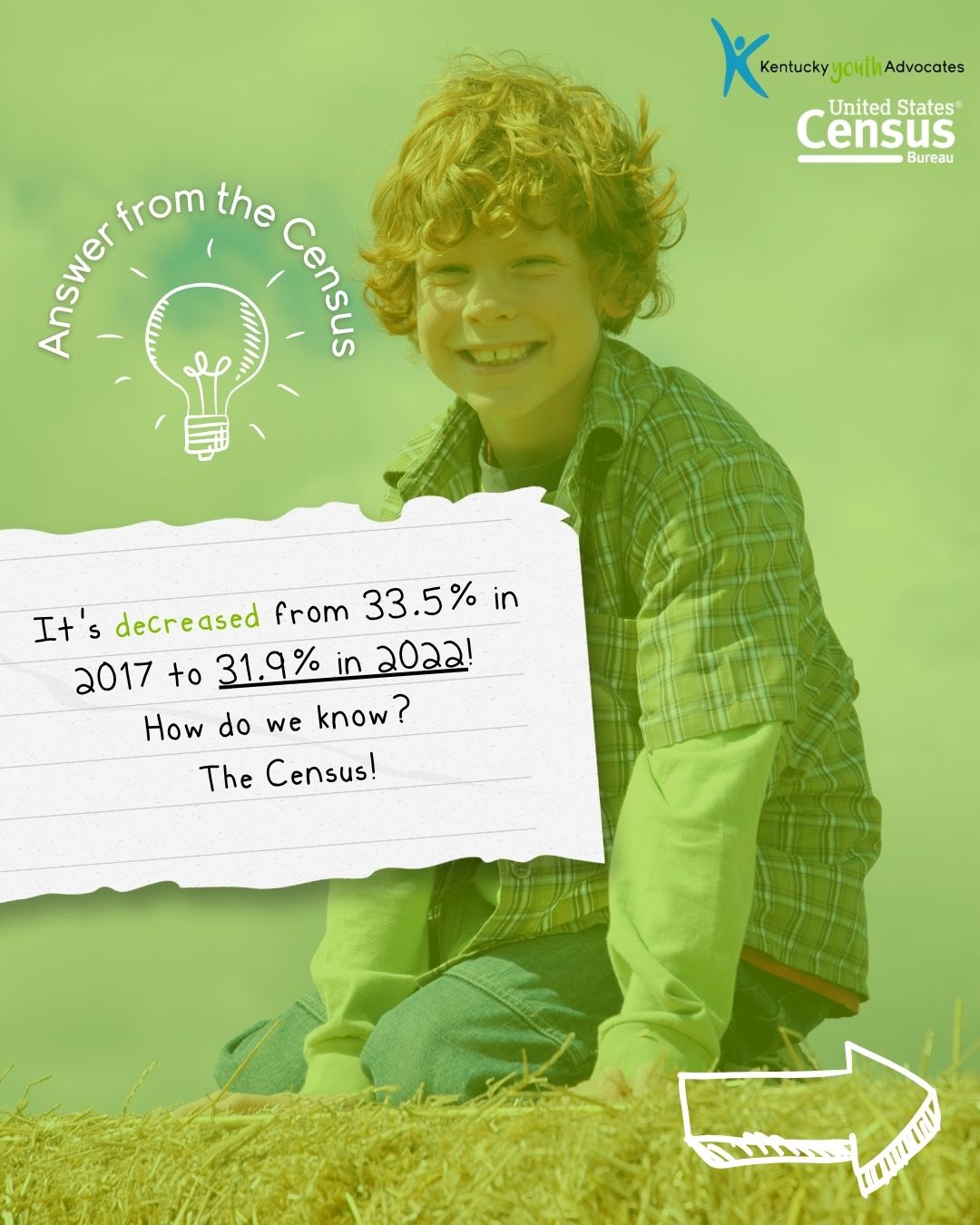
It’s decreased from 33.5% in 2017 to 31.9% in 2022! How do we know? The Census!
The Census and the American Community Survey (ACS) provide valuable data that helps the government decide how much federal dollars Kentucky receives to fund supportive services, such as SNAP and Medicaid.
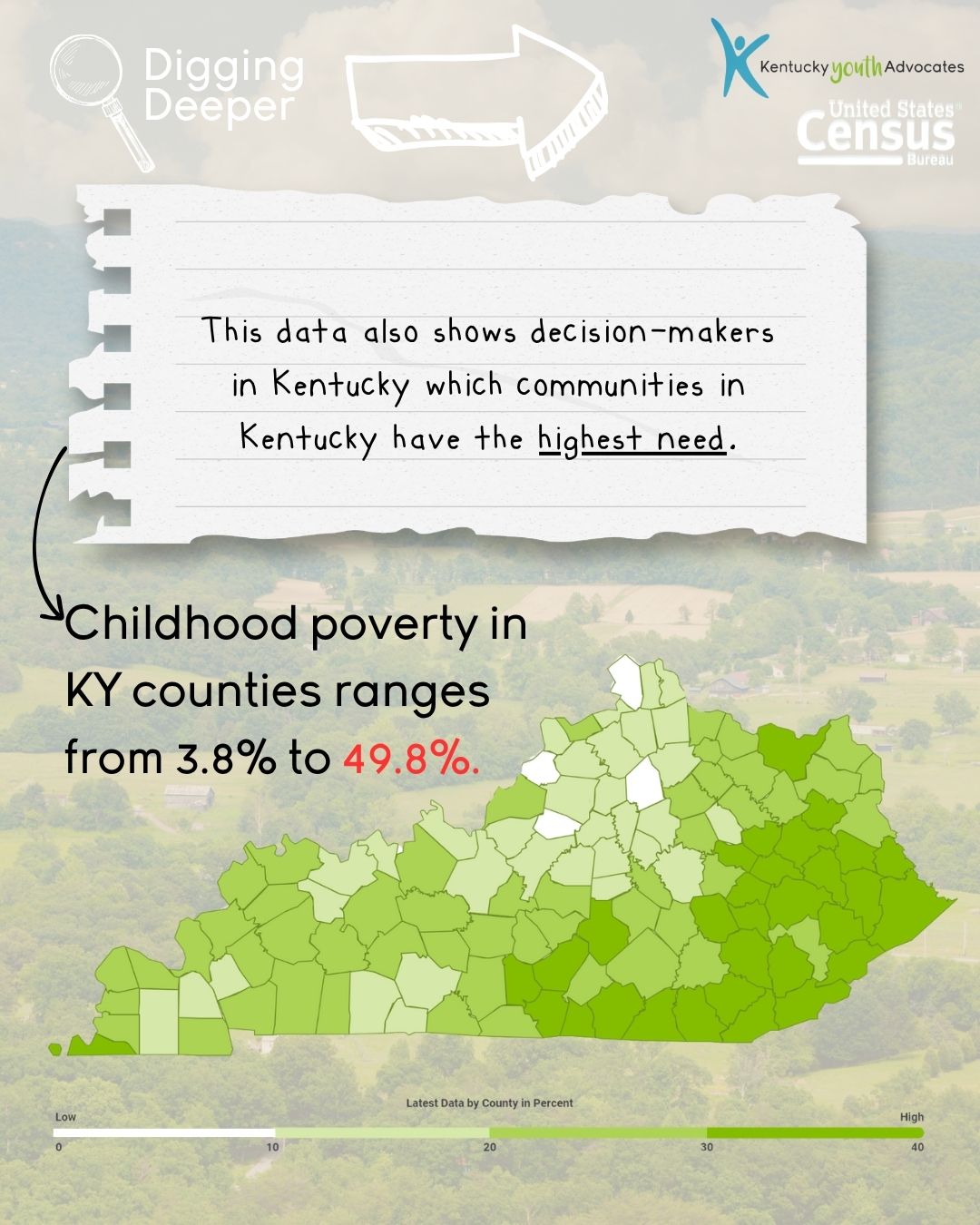
This data also shows decision-makers in Kentucky which communities in Kentucky have the highest need.
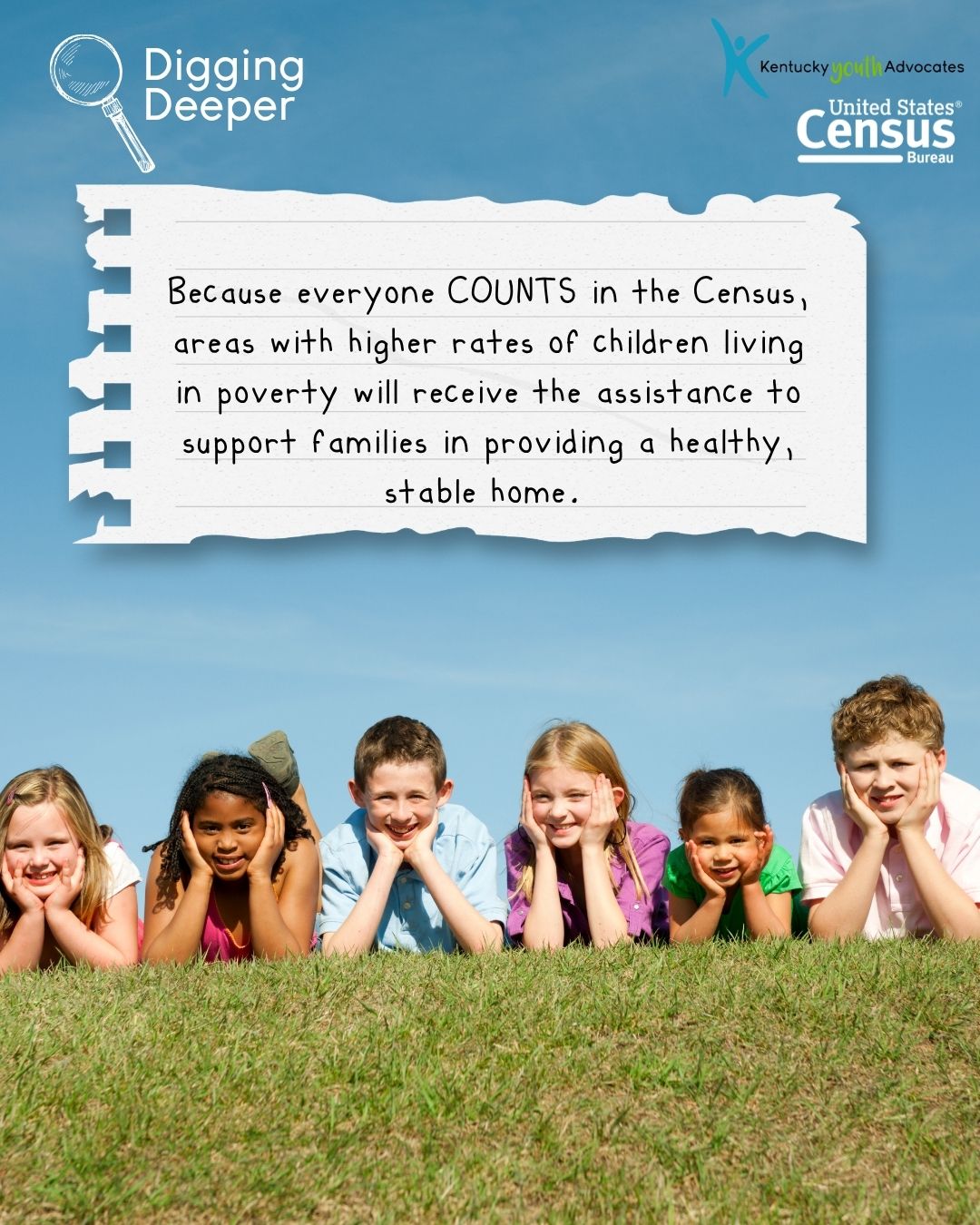
Because everyone counts in the Census, areas with higher rates of children living in poverty will receive the assistance they need to ensure all children are able to live in healthy, stable homes. Source: Kids Count
Carousel 2: Education
How does the Census impact Kentucky schools? It plays an important role in how funding is distributed to schools.

How? When it is hard to meet basic needs, like having enough food or stable housing, children’s education can suffer. To support children in low-income families, schools receive funding from the federal government to support students. The Census Bureau provides poverty estimates to school districts, which are used to allocate Title 1 funds to local schools with the highest percentages of children from low-income families.
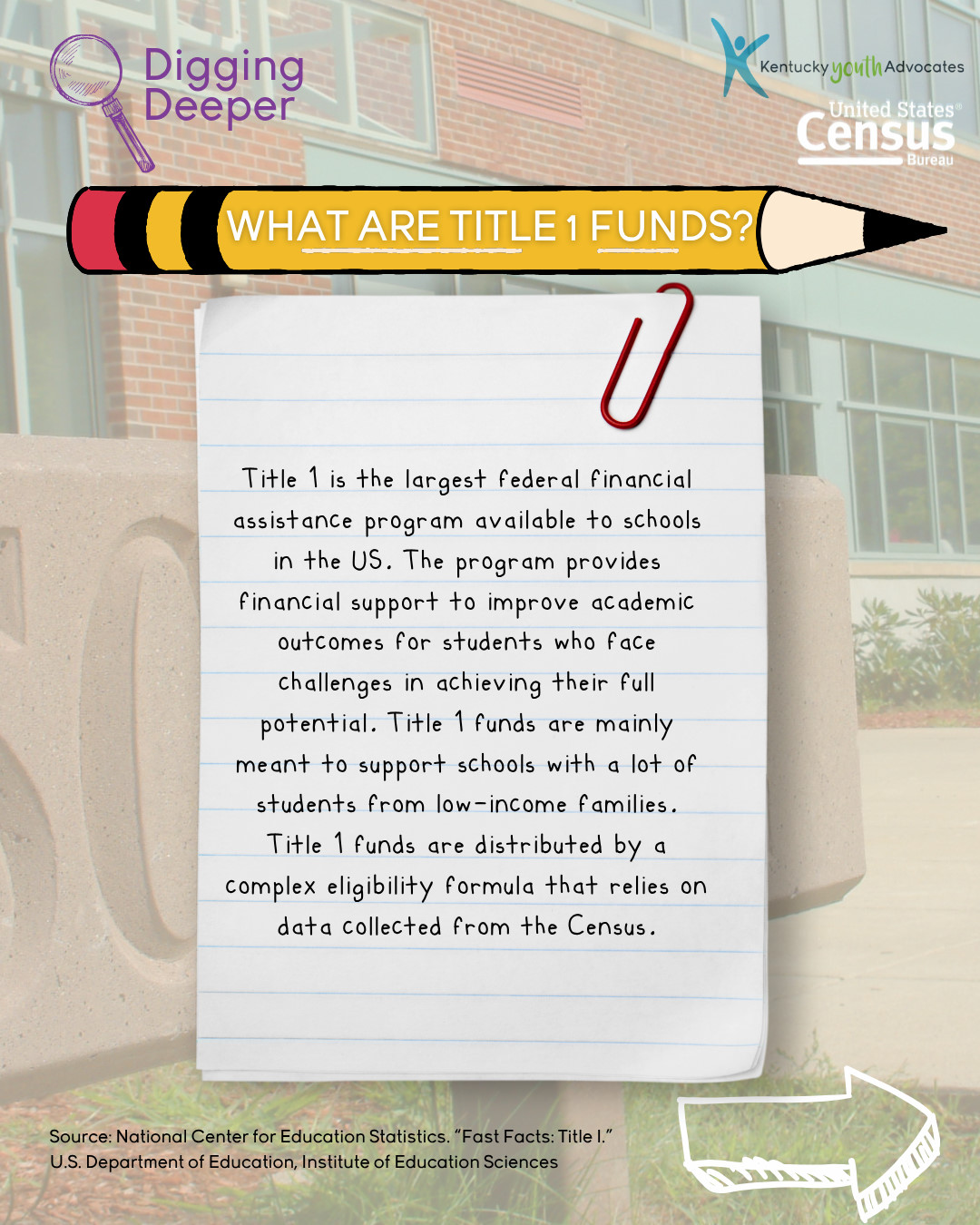
Title 1 is the largest federal financial assistance program available to schools across the US. The program provides financial support to improve academic outcomes for students who face challenges in achieving their full potential. Title 1 funds are intended primarily for schools with high proportions of students from low-income families. The allocation of Title 1 funds follows complex eligibility criteria and distribution formulas that are dictated by data collected from the Census. Source: https://nces.ed.gov/fastfacts/display.asp?id=158#:~:text=Title%20I%2C%20Part%20A%20
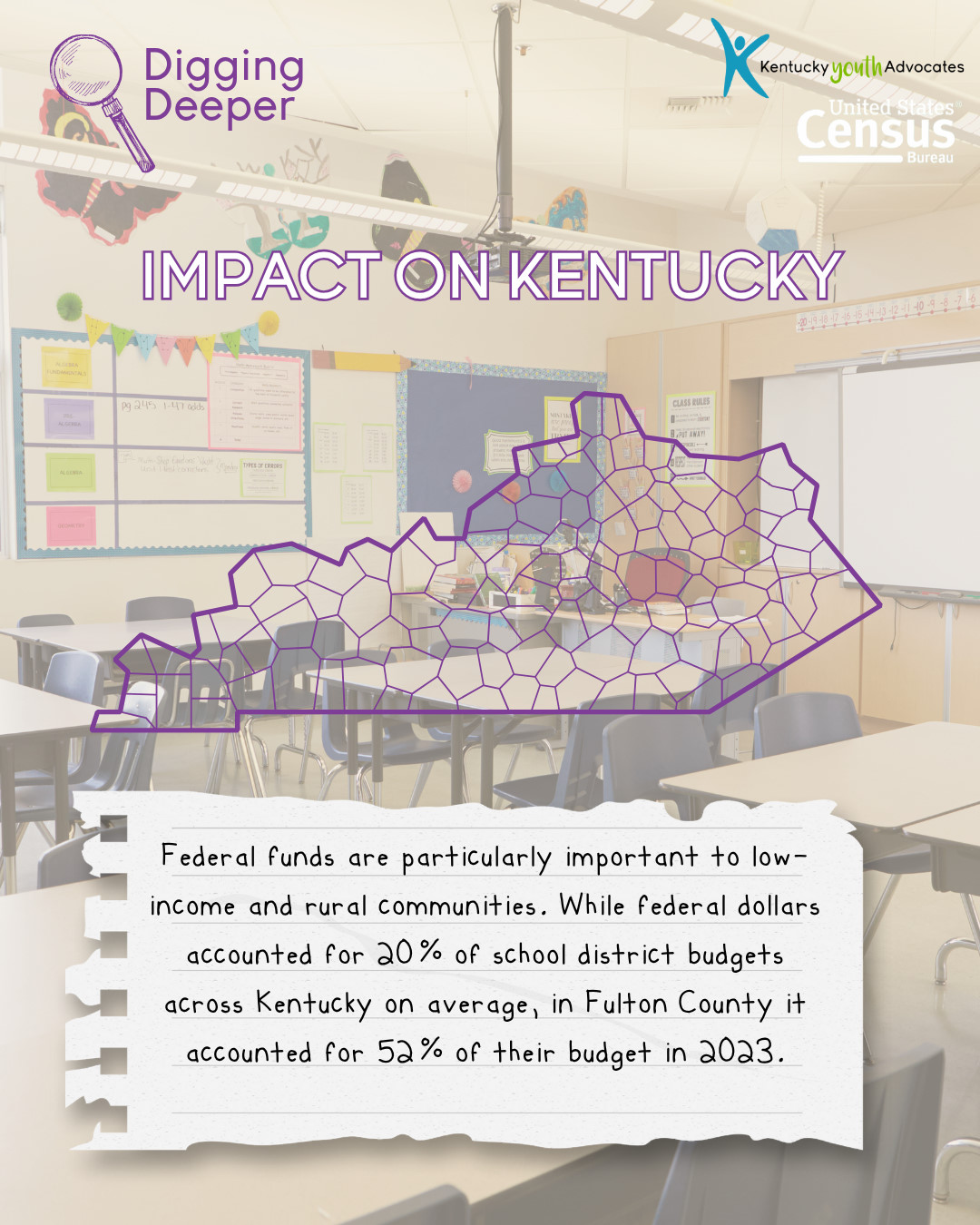
Impact on Kentucky; Federal funds are particularly important to low-income and rural communities. While federal dollars accounted for 20% of school district budgets across Kentucky on average, in Fulton County it accounted for 52% of their budget in 2023.
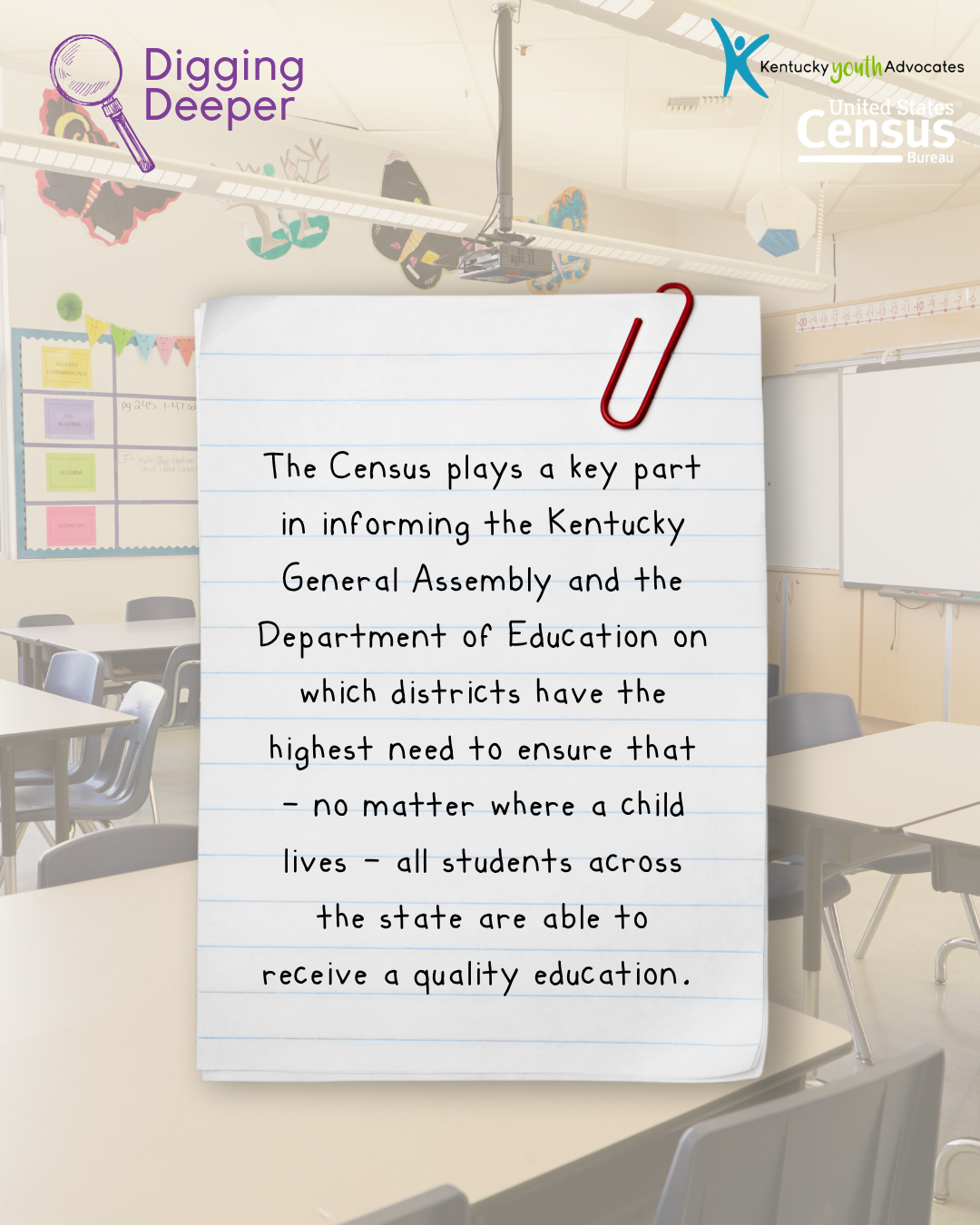
The Census plays a key part in informing the Kentucky General Assembly and the Department of Education on which districts have the highest need to ensure that - no matter where a child lives - all students across the state are able to receive a quality education.
Carousel 3: Grandparent-led households
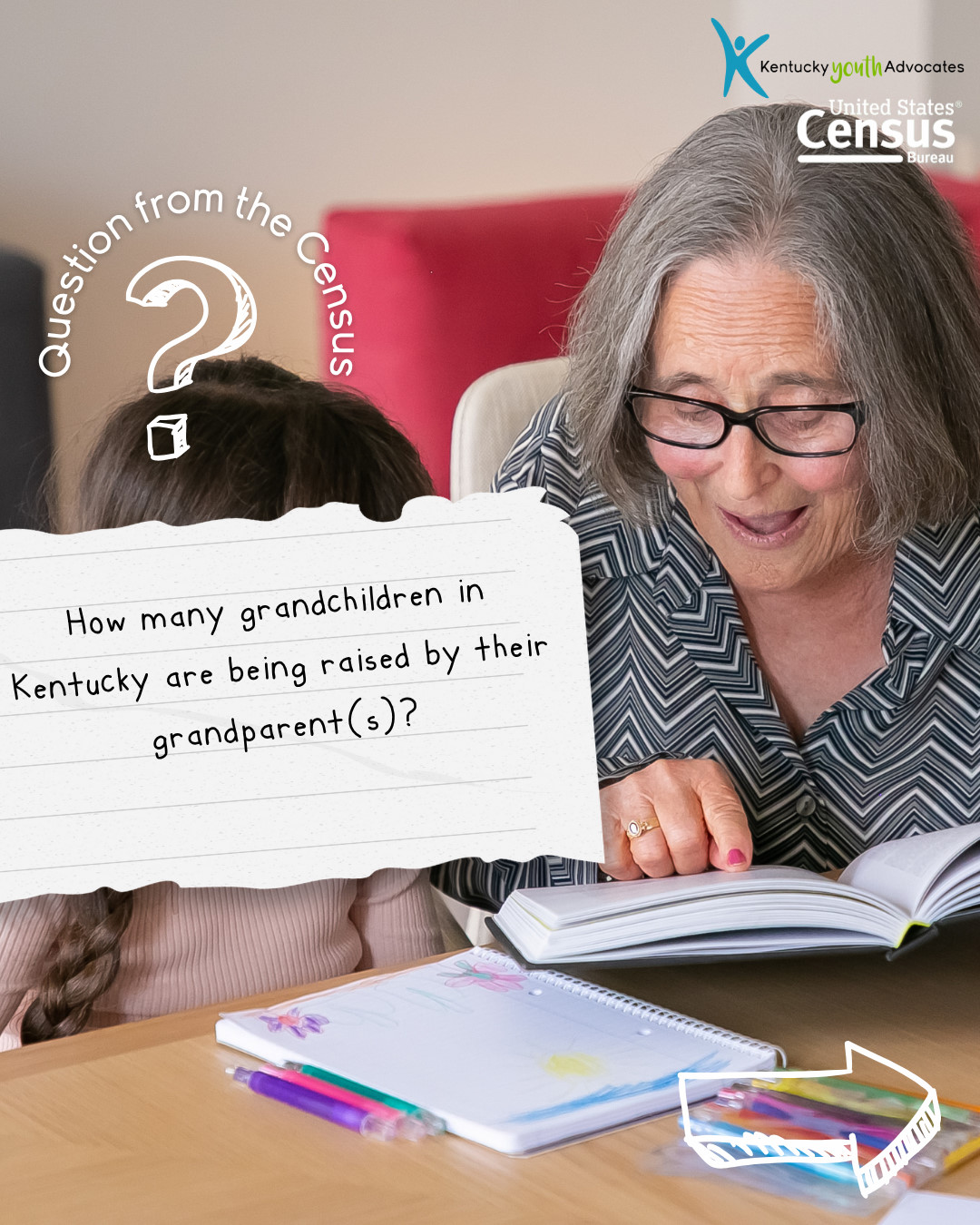
Family members across Kentucky step up to care for children when their parents are not able to care for them. How many grandchildren in Kentucky are being raised by their grandparent(s)?
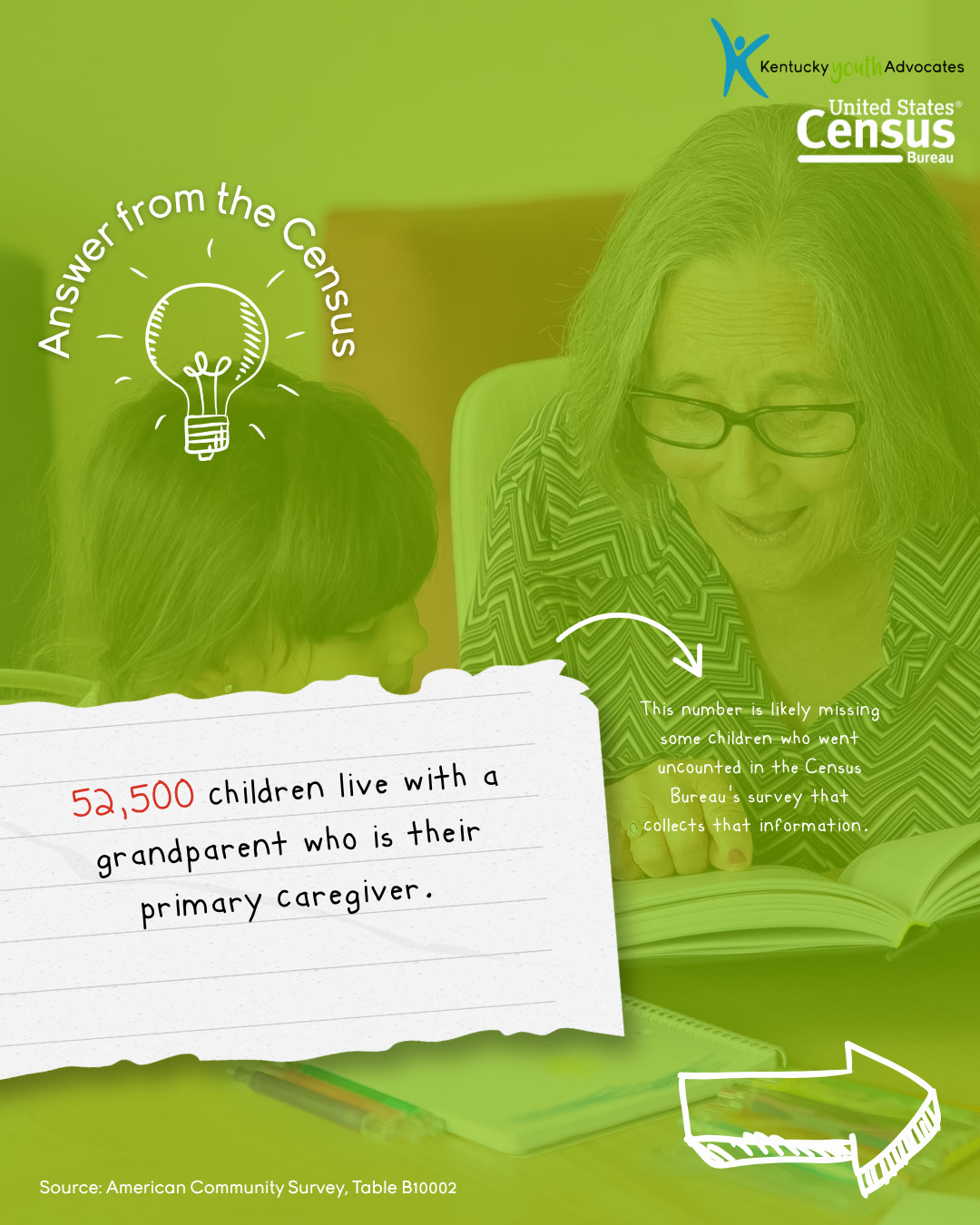
Currently, 52,500 children live with a grandparent who is their primary caregiver. However, the number is likely missing some children who went uncounted in the Census Bureau’s survey that collects that information. Source: American Community Survey, Table B10002
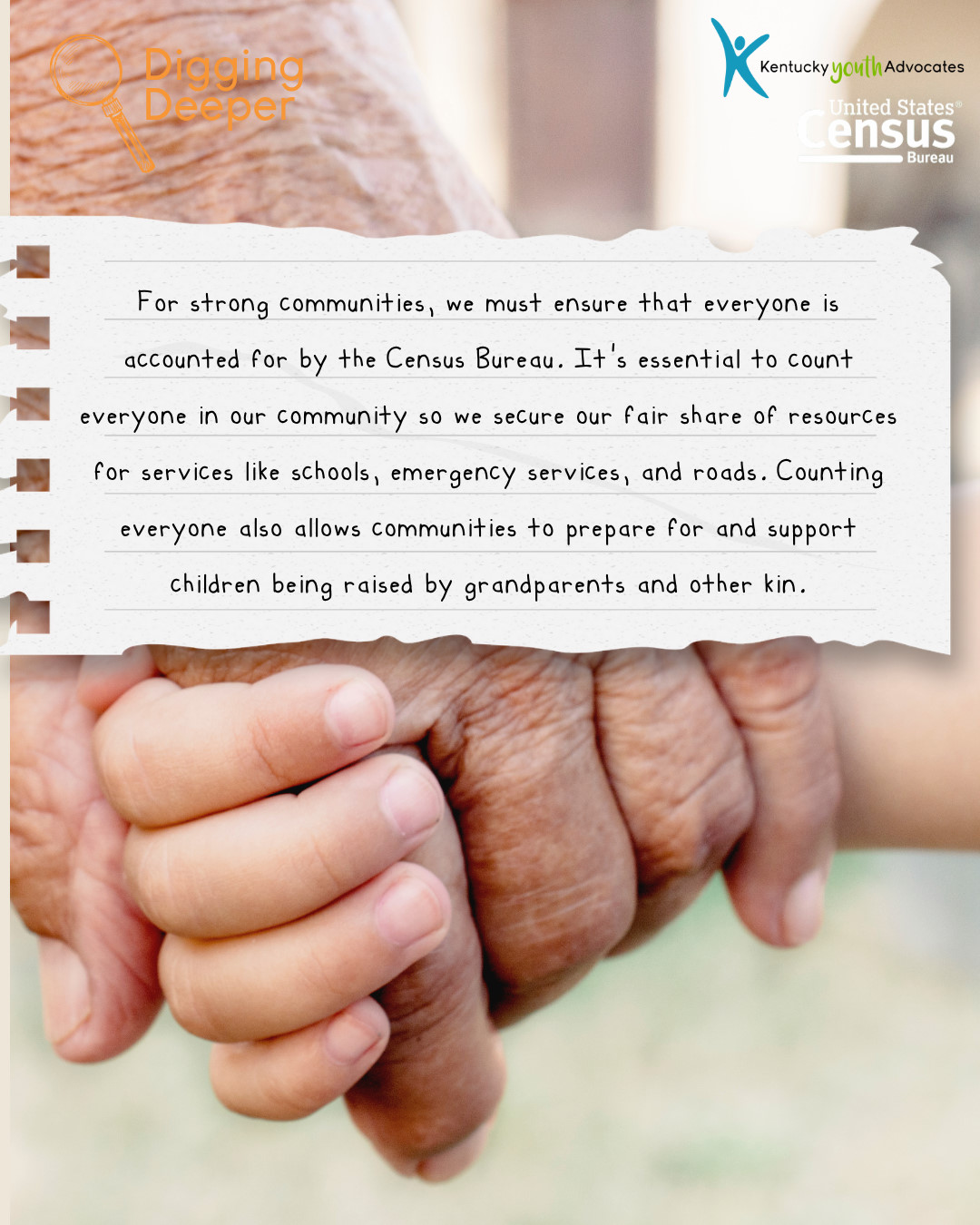
For strong communities, we must ensure that everyone is accounted for by the Census Bureau. It’s essential to count everyone in our community to ensure we receive our fair share of resources for services like schools, emergency services, and roads. Counting everyone also allows communities to prepare for and support children being raised by grandparents and other kin.
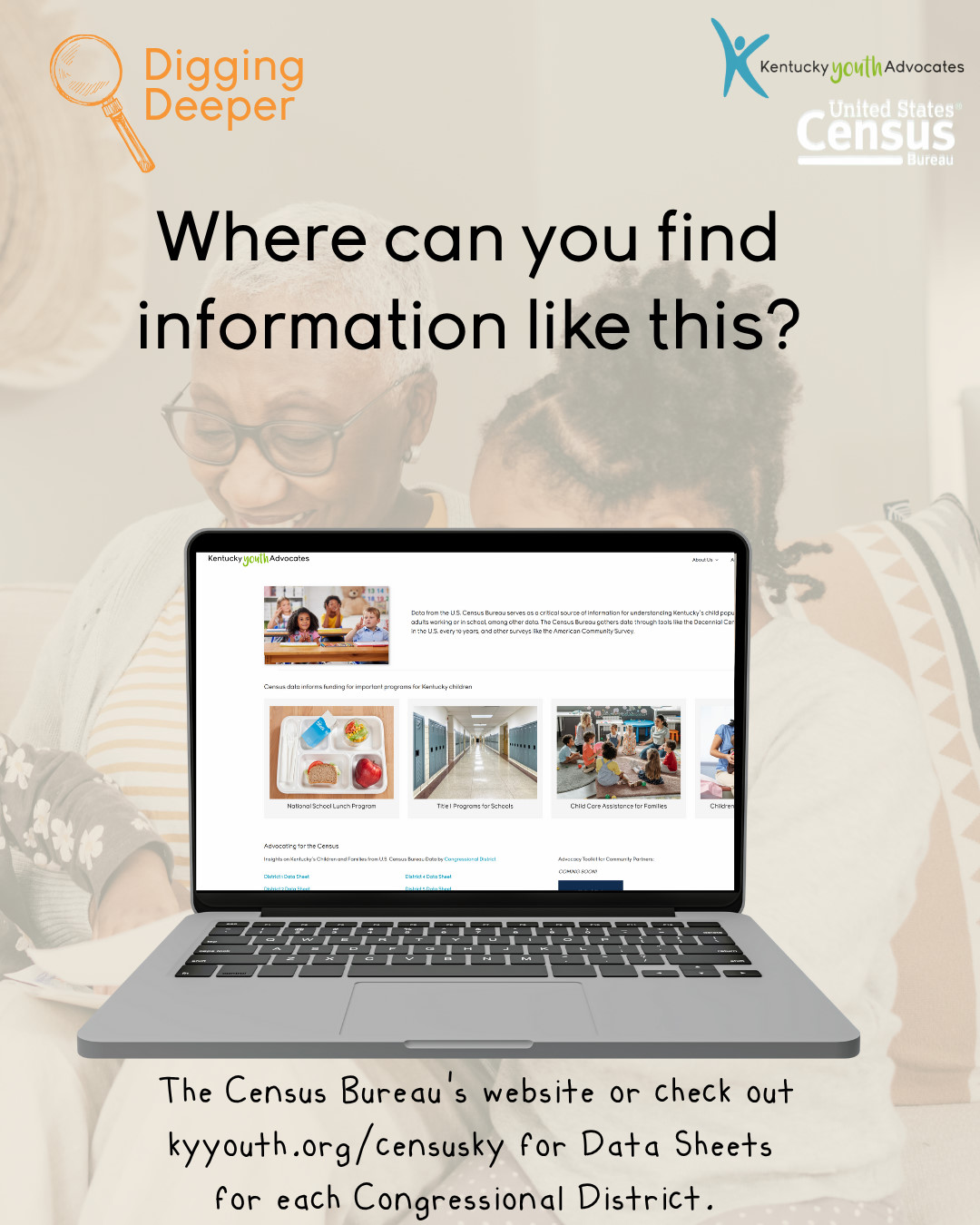
Where can you find information like this? The Census Bureau’s website or check out kyyouth.org/censusky for Data Sheets for each Congressional District.
The Census Bureau does more than just a headcount—it holds powerful data that tells the story of how Kentucky communities are doing, shapes over a trillion dollars in federal funding, decides Congressional representation, and guides community resources and planning.
Everyone benefits from a strong Census Bureau, whether it be through data that helps you understand community needs, grants that support rural healthcare, or programs that ensure pregnant women and children have the nutrition they need to stay healthy.
Help ensure high-quality data and vital services by calling, emailing, or writing your Members of Congress and advocating for a fully funded, nonpartisan Census Bureau.
Sample Letter/Email
Dear Rep/Sen _____,
I am writing today to discuss the importance of the Census Bureau and its functions to me and my community.
Businesses and community organizations use this data to plan local development and services, and our local government uses it for infrastructure allocation and planning and resource distribution. My personal experience with using (Census data/programs that use the Census) is (insert a couple of sentences about how you have used Census data or a program that uses the Census).
This information is critical to how my community functions, and I would like to ask you to fully fund the Census Bureau to allow it to do its job, and continue to ensure its operation as a nonpartisan data source that supports the entire country.
Sincerely,
(name)
(zip code)
Take Action
-
Ask your U.S. Senator and Member of Congress to fully fund the Census Bureau.
-
Educate your local decision makers about the Census and the impact the Census has in your community.
-
Use Census data to identify your communities’ needs and priorities for action.
-
Share information about the Census on social media. Use this toolkit to access sample social media posts!