
The Impact of Eviction on Families in Kentucky

The average family facing eviction in Kentucky has at least one child in the household, and national data shows households with children are 2x more likely to face eviction than other households. When families face eviction, children suffer the most. The experience is linked to educational disruption, food insecurity, as well as negative physical and mental health outcomes.
Kentucky can promote family housing stability and improve child well-being by making common sense changes to the eviction process.
Don’t know what Kentucky House and Senate district you live in? Look up your legislators!
If you would like to save a profile click the download symbol (top right) and select PDF or image file format.
Note: District profiles include data for all counties within a district. For districts that include only part of a county, data for the entire county is still included.
Don’t know what Kentucky House and Senate district you live in? Look up your legislators!
If you would like to save a profile click the download symbol (top right) and select PDF or image file format.
Note: District profiles include data for all counties within a district. For districts that include only part of a county, data for the entire county is still included.
Eviction 101
- What is an eviction? An eviction, or a “forcible detainer”, is the legal process a landlord uses to remove a tenant from a rental property.
- What is a filing? A filing is the first step in the eviction process and occurs when a landlord files a forcible detainer with the court against a tenant to remove them from the property.
- What is an eviction record? An eviction record is created as soon as a landlord files a claim for eviction with the court. Even if the case is dismissed or doesn’t result in an eviction, the tenant has a mark on their housing record which can be viewed by any prospective landlord when applying for future housing.
- What is a dismissal? A dismissal is when the court ends an eviction case without making a judgment. An eviction may be dismissed for reasons such as procedural errors, insufficient evidence, or a settlement/agreement.
- What is a judgment? A judgment is when the court makes a decision in an eviction case either in favor of the landlord or the tenant. A judgment in favor of the landlord means that the eviction can legally go through. A judgment in favor of the tenant means that the tenant can remain in the property.
- What is an eviction warrant? An eviction warrant allows the Sheriff’s Department to remove a tenant and their possessions from the property on behalf of a landlord. Not every eviction case has a warrant filed, as tenants have seven days after a judgment is made in favor of a landlord to voluntarily leave the property.
- Learn more about what the eviction process looks like.
- The most common age to experience eviction in the U.S. is during childhood.
- Black renters are disproportionately impacted by eviction.
- Less than 1 in 5 renters in the U.S are Black (18.8%), but over half of all eviction filings are against Black renters (51.1%).
- 27% of Black children under 5 in rental households face eviction each year.
- In the immediate, an eviction causes a family to lose their home, which often means parents move farther away from jobs, kids away from school, and families away from their community and support systems.
- Long-term, an eviction also creates a mark on an individual’s housing record that makes it difficult to secure future housing. Landlords often screen potential tenants for an eviction record, and even a dismissed eviction or judgment in favor of a tenant can be a reason for denial. Families with an eviction record, even if the case is dismissed, encounter long-term barriers to securing stable housing and regularly experience housing instability or homelessness.
- Research also shows that an eviction increases the likelihood of job loss and is associated with reduced earnings.
- Eviction affects the health of children and families and is linked to adverse birth outcomes, food insecurity, maternal depression, and increased mental health challenges among children. Children in households facing eviction experience educational disruptions, including increased absences from school.
- What is an informal eviction? An informal eviction is when a landlord forces a tenant to leave a property without going through the court system.
- What does an informal eviction look like? An informal eviction can look a number of different ways, such as a landlord telling a tenant to leave the property or engaging in illegal tactics such as changing the locks, removing a tenant’s belongings, or shutting off their utilities.
- Why are informal evictions not included in this dataset? Informal evictions happen outside of the formal court and record system, making them difficult to track. Research indicates that informal evictions are particularly common in rural areas.
Eviction 101
Evictions in Kentucky
Evictions happen in all 120 Kentucky counties. Hover over your county on the map below to explore eviction data. Data encompasses all evictions that were filed, dismissed, or received a judgment in court in a county between 2022-2024. Note: To protect the privacy of families represented in this data, we suppressed data for counties with fewer than six evictions filed across the three-year period. Data that has been suppressed will be denoted with a *.
Evictions happen year-round in Kentucky, including crucial times for families like back-to-school. The graph below highlights the average number of evictions filed by month between 2022-2024.
Tenants facing eviction in Kentucky* are not guaranteed the right to an attorney.
- Many renters cannot afford legal representation and must navigate the complex eviction process on their own. Nationally, only 3% of tenants have legal representation in eviction cases, compared to 82% of landlords, a disparity that leads to more favorable outcomes for landlords.
- In Kentucky, fewer than 2% of renters are represented by an attorney during eviction proceedings. Renters in rural areas face even greater barriers with only 1.7% of rural renters in Kentucky having legal representation in eviction cases.
- Research shows that having legal representation leads to better outcomes for renters. Yet, an analysis of Kentucky eviction cases found that renters in rural areas are nearly twice as likely to be evicted as those in urban areas.
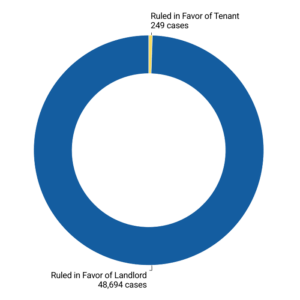
- The graph below highlights the number of eviction judgments that were issued in favor of either the landlord or the tenant in Kentucky between 2022-2024.
*NOTE: Louisville Metro Government, through a partnership with the Legal Aid Society, operates a Right to Counsel program that provides legal representation to qualifying, low-income Louisville families. The program has consistently yielded positive results for tenants, with 100% of clients who received direct legal representation through Louisville’s Right to Counsel program either avoiding or delaying their eviction, and 734 children indirectly benefiting from their parent or guardian’s legal representation. To learn more about Louisville’s Right to Counsel program, visit Results for America.
Evictions in Kentucky
Evictions happen in all 120 Kentucky counties. Hover over your county on the map below to explore eviction data. Data encompasses all evictions that were filed, dismissed, or received a judgment in court in a county between 2022-2024. Note: To protect the privacy of families represented in this data, we suppressed data for counties with fewer than six evictions filed across the three-year period. Data that has been suppressed will be denoted with a *.
Evictions happen year-round in Kentucky, including crucial times for families like back-to-school. The graph below highlights the average number of evictions filed by month between 2022-2024.
Tenants facing eviction in Kentucky* are not guaranteed the right to an attorney.
- Many renters cannot afford legal representation and must navigate the complex eviction process on their own. Nationally, only 3% of tenants have legal representation in eviction cases, compared to 82% of landlords, a disparity that leads to more favorable outcomes for landlords.
- In Kentucky, fewer than 2% of renters are represented by an attorney during eviction proceedings. Renters in rural areas face even greater barriers with only 1.7% of rural renters in Kentucky having legal representation in eviction cases.
- Research shows that having legal representation leads to better outcomes for renters. Yet, an analysis of Kentucky eviction cases found that renters in rural areas are nearly twice as likely to be evicted as those in urban areas.
- The graph below highlights the number of eviction judgments that were issued in favor of either the landlord or the tenant in Kentucky between 2022-2024.
*NOTE: Louisville Metro Government, through a partnership with the Legal Aid Society, operates a Right to Counsel program that provides legal representation to qualifying, low-income Louisville families. The program has consistently yielded positive results for tenants, with 100% of clients who received direct legal representation through Louisville’s Right to Counsel program either avoiding or delaying their eviction, and 734 children indirectly benefiting from their parent or guardian’s legal representation. To learn more about Louisville’s Right to Counsel program, visit Results for America.
Contributing Factors
Housing affordability: The cost of housing has risen significantly in Kentucky in recent years. Between 2018-2022, 44% of Kentucky renters paid more than one-third of their income towards housing, which can force families to make difficult choices about whether to pay for rent or other basics like food, medicine, and utilities. Additionally, when so much of your income goes towards basic needs like housing, one accident or illness and missed days of work can lead to the inability to pay rent and make eviction more likely.
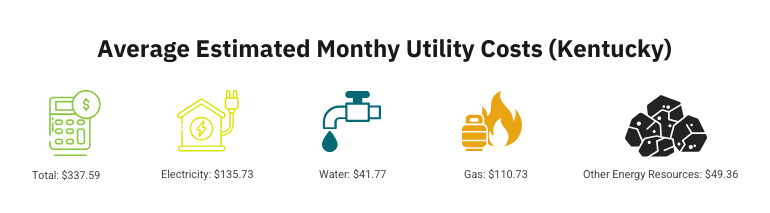
Utility cost: Energy prices have risen roughly twice as fast as inflation since the COVID-19 pandemic, squeezing the budget of low and middle income families and making it harder for them to afford other expenses like rent. Missing a utility payment can be considered a lease violation and grounds for eviction.
Policy Solutions
State Policy Solution: The Kentucky General Assembly can reduce the harmful impacts of eviction on kids and families by making common sense changes to the eviction process to automatically expunge dismissed evictions and prohibit minors from being named on eviction records.

- Dismissals: In Kentucky, an eviction record is created the moment a landlord files a claim for eviction with the court. Families with an eviction record, even if the case is dismissed, often encounter long-term barriers to securing stable housing.
Kentucky can remove the barrier that many Kentuckians face when trying to secure housing by automatically expunging dismissed eviction cases. - Protect minors: Individuals under 18 cannot legally sign a lease in Kentucky, yet sometimes children in a household are listed on an eviction filing. This results in children having an eviction record before they are even old enough to sign a lease which can contribute to long-term housing barriers.
Kentucky can protect the future well-being and housing security of children by ensuring that minors are not named on eviction filings.
Stay involved:
- Stay up-to-date on meetings and efforts of the Kentucky Housing Taskforce.
- Contact your state legislator and ask them to support making common sense changes to the eviction process to reduce the harmful impact of eviction on Kentucky kids and families. Visit KYA’s Advocacy page for more information on contacting your legislator.
- Get involved in the Blueprint for Kentucky’s Children and subscribe to regular email updates.