
There has been a great deal of information about Autism in the media lately. These discussions about Autism have brought to life accurate information about this condition, as well as misconceptions. As many organizations look at how to support individuals with Autism, it is essential to make sure that these supports are built on facts regarding the diagnosis.
What is Autism?
Autism is a developmental disability that predominantly affects the social and emotional domains of development. It is not contagious or an epidemic. One of the key components to consider about Autism is that it, like several other neurodivergent conditions, causes the individual’s brain to process information in a slightly different way than the typical person.
With these differences, Autistic children and adults may excel in certain areas, and they will have challenges in other areas. Strengths could include a detailed memory, an ability to excel at mathematical equations, and aptitude for creativity. Challenges often include difficulty communicating with others, difficulty identifying and controlling emotions, having a difficult time with changes in routines, or an increased rate of learning disabilities.
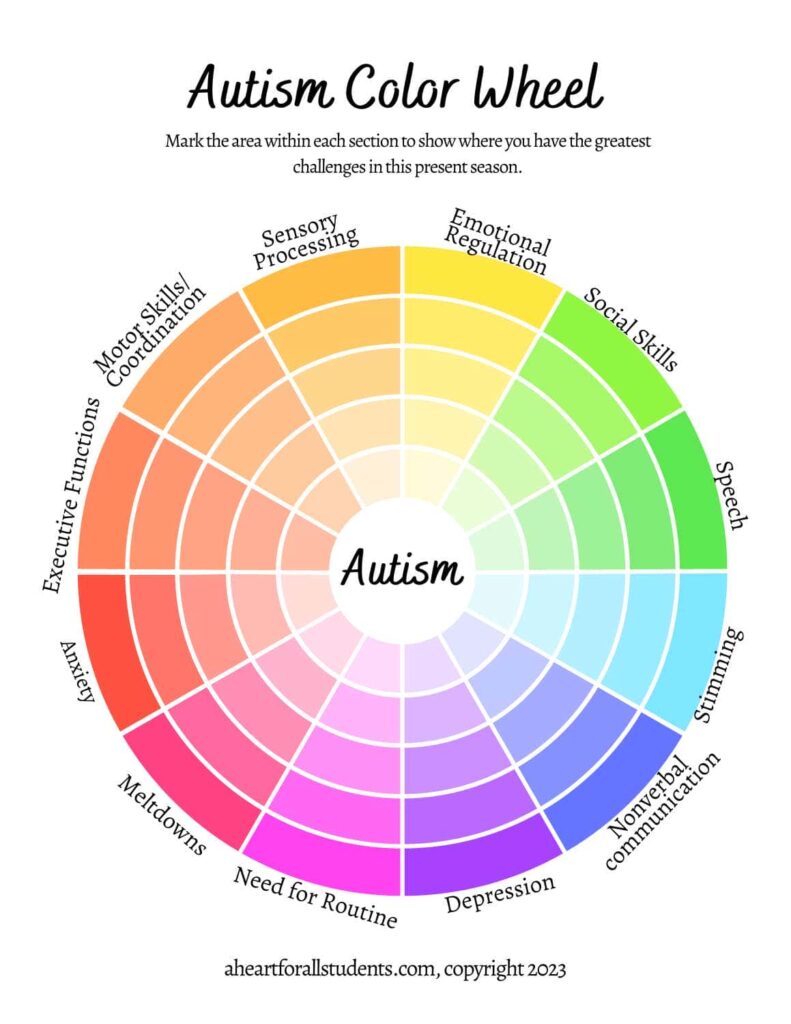
Downloaded from https://www.getsafe.com/autism-wheel-vs-the-autism-spectrum/.
What are the signs and symptoms of Autism?
It is important to remember that Autism is a spectrum disorder. That means that Autism has a wide range of traits that could be present, so no two individuals with Autism will present the same combinations of symptoms. It is also important to understand that this spectrum of symptoms does not look like a straight line from the “mildest” case of Autism to the “most severe” case of Autism.
Instead, each individual case of Autism may look a little more like a pie chart where certain individuals struggle more with several traits, but other traits may not be as much of a challenge for that particular child or adult. These characteristics could include traits like emotional regulation, social skills, stimming behaviors, anxiety, motor delays, communication skills, cognitive abilities and dependence on routines.
What are the risk factors of Autism?
At this point, there is no specific cause identified for why children are being diagnosed with Autism. Like many other chronic conditions, such as Epilepsy or Diabetes, it appears that both environmental and genetic factors could influence an Autism diagnosis. There are specific risk factors that are linked to the diagnosis such as:
- A sibling has already been diagnosed with Autism
- A child is born to older parents
- A child has a chromosomal-linked trait like Fragile X or Tuberous Sclerosis
- There are complications at birth
- Research shows that boys are documented to have an Autism diagnosis three to four times more frequently than girls
How prevalent is Autism?
The Center for Disease Control (CDC) recently reported that 1 in 31 children (at 8 years of age) are diagnosed with Autism in the US. That means that in an elementary school classroom, approximately one or more children in each classroom has this diagnosis. These numbers have dramatically increased since 2010 when 1 in 68 children were diagnosed with Autism.
This growth rate is troubling, but it is important to remember that a couple of factors have contributed, including:
- Teachers and pediatricians have become much more aware of what early signs of Autism look like, so many more children have been referred for evaluations compared to previous decades. In prior years, many of these children may have gone undiagnosed or were misdiagnosed with other disabilities or learning challenges.
- In 2013, the previous diagnosis of Asperger’s Syndrome was eliminated and rolled into the Autism Spectrum Disorder diagnosis. Asperger’s was what many people believed to be a “milder” version of Autism. Eventually the diagnostic community felt that the differences in Asperger’s and Autism were not significant enough to warrant two different diagnoses.
What resources and supports are available to children with Autism and their families?
Recent news stories have addressed that family life can be very challenging when a child in the home has Autism. This is not a false statement, but the key to supporting these families is to direct them towards appropriate and necessary resources.
- If a family suspects that a child may have Autism, or is displaying some of the traits associated with Autism, they need to seek medical or diagnostic help. In Kentucky, there are free services available for diagnosis.
- If a child is under the age of three, the family can reach out to the Kentucky Early Intervention System (KEIS). This service can support the family through diagnosis and therapy programs.
- If the child is three years of age or older, the family can reach out to their local public school system and request an evaluation. Even if the child is not currently attending the public school system, the local school can help the family begin the evaluation process and see if the child qualifies for services.
- Families also have the ability to reach out to a private child psychologist for evaluation as well; however, that cost would be at the expense of the family.
- If a child is diagnosed with Autism, it is crucial that the child receive the necessary support services to help overcome challenges that he or she is experiencing. Not every child with Autism will experience the same challenges, so each child will need unique support.
- These children may need speech therapy, occupational therapy, physical therapy, or mental health counseling to provide support for traits like anxiety.
- Many children with an Autism diagnosis may also need to see a child psychiatrist if medication is needed as part of the treatment plan.
- If the child receives any of these services through private insurance instead of through the public school system, then it can benefit the family to make sure that the insurance company knows the child has an official Autism diagnosis so that more services will be covered on the insurance plan.
- Most children with Autism will also qualify for special education services through the public school system, depending on how the diagnosis affects the child’s academic performance. This means the child will receive an Individual Education Plan (IEP), and the school will provide special education for the child and make accommodations so that he or she can be successful in school.
- The IEP is created by a group of educators and specialists in the school system, but the parents/caregivers are also a vital part of that team.
- Parents often need to speak up to make sure that their children receive all the benefits necessary to be successful at school.
- In order to participate in these meetings, it is important for parents to understand their rights as a member of the team.
- Finally, it is so important for parents to get respite when needed.
- There is definitely an increased stress level when you raise a child with Autism. It is stressful raising a child under the best of circumstances, but when a disability is involved, that stress increases.
- Many parents may not have a family member or babysitter they feel comfortable leaving their child with in order to have a small break. This is when it is essential for parents to have a network of support to step in and help. Trusted family members and friends are crucial.
- It is also key to know about community organizations like Critically Loved or FEAT of Louisville that focus on helping families with children that have special needs.
 My Family’s Story
As the mom of a child with Autism, I can tell you that life with a child with special needs is very challenging. I doubt my decisions on a regular basis, and I stay on high alert to make sure that his needs are being met. I can also say that celebrating my son’s victories with him is a special kind of amazing! I would not change anything about him. We continue to work with his therapy team and his special educators to make sure that he is as successful as possible. My family depends on trusted doctors and specialists to provide the resources we need for him.
The key to my son’s success is not to focus on the challenges or opportunities that he may be missing out on, but instead to focus on his strengths and accomplishments. That is what gives us hope and makes life much more exciting each day.




Fantastic post! Your insights are both informative and inspiring. Thanks for sharing such valuable content!