
 All children deserve to learn and grow in an encouraging and supportive environment that reduces the risk of system involvement. Yet, recent legislative changes have led to more children and parents entering the court system for truancy. Truancy is defined as missing three or more days of school or being tardy on three or more days without a valid excuse. Any child who is reported as truant two or more times in a one year period is considered habitually truant.
While it’s critical to ensure every child is consistently attending school, it’s equally important to address barriers that families may be experiencing to prevent unnecessary involvement with the juvenile or family court systems.
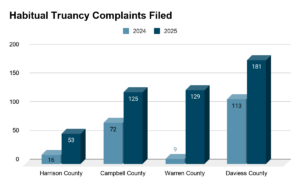
Statewide habitual truancy complaints have increased from 2,872 in 2024 to 3,448 in 2025, with county-level data showing several significant increases as well.
Over the past year, stakeholders and advocates across Kentucky have stepped up to help identify the root causes of educational challenges for families and test innovative solutions. Relatedly, one budget priority of the Blueprint for Kentucky’s Children this year is to expand funding and access to parent engagement meetings, which have shown promising results towards preventing parent involvement with the child welfare system for educational neglect. We’ve also seen legislators take critical steps to meaningfully address truancy on a community-level. Companion bills were filed by Senator Brandon Storm (SB 170) and Representative Jason Nemes (HB 592) to establish a pilot program to address barriers to attendance for students in 6th-12th grade.
The pilot program, called Supporting Opportunities for Accountability and Restoration (SOAR), would be created and operated by the Administrative Office of the Courts and would require the following:
- At least ten school districts to participate in the SOAR program for four years unless that timeline is extended or limited by the General Assembly.
- Parents and students to participate in the SOAR program if the student has more than five unexcused absences in a school year.
- Schools to establish Responsive Interventions to Support and Empower (RISE) teams – consisting of the Director of Pupil Personnel, a Family Resource and Youth Service Center worker, the school social worker or counselor, the school resource officer, a Court Designated Worker, and a representative from the Department for Community Based Services – to work with families to address attendance challenges and barriers to students successfully completing their diversion programs for status offenses.
The data on habitual truancy represents real children, but it doesn’t explain why they’re struggling to attend school regularly. Without getting to the root causes of a child’s educational challenges early, the trajectory of their future could be negatively impacted. SB 170 and HB 592 aim to prevent more children from unnecessary involvement with the juvenile justice system and to create spaces for families to receive ongoing support and effective solutions.
Follow along on KYA’s bill tracker to see progress as SB 170 moves closer to final passage.





Leave A Comment