
Contact:
Mara Powell
mpowell@kyyouth.org
502-895-8167 X122
Chronic Absences, Drop in Test Scores: Kentucky Ranks 38th in 2024 KIDS COUNT Data Book Urging Focus on Equipping Kids to Learn
50-State Data Show Academic Outcomes, Absence are Linked to Poverty, Trauma; Policymakers Must Act to Promote Kids’ Future Success, Annie E. Casey Foundation Finds
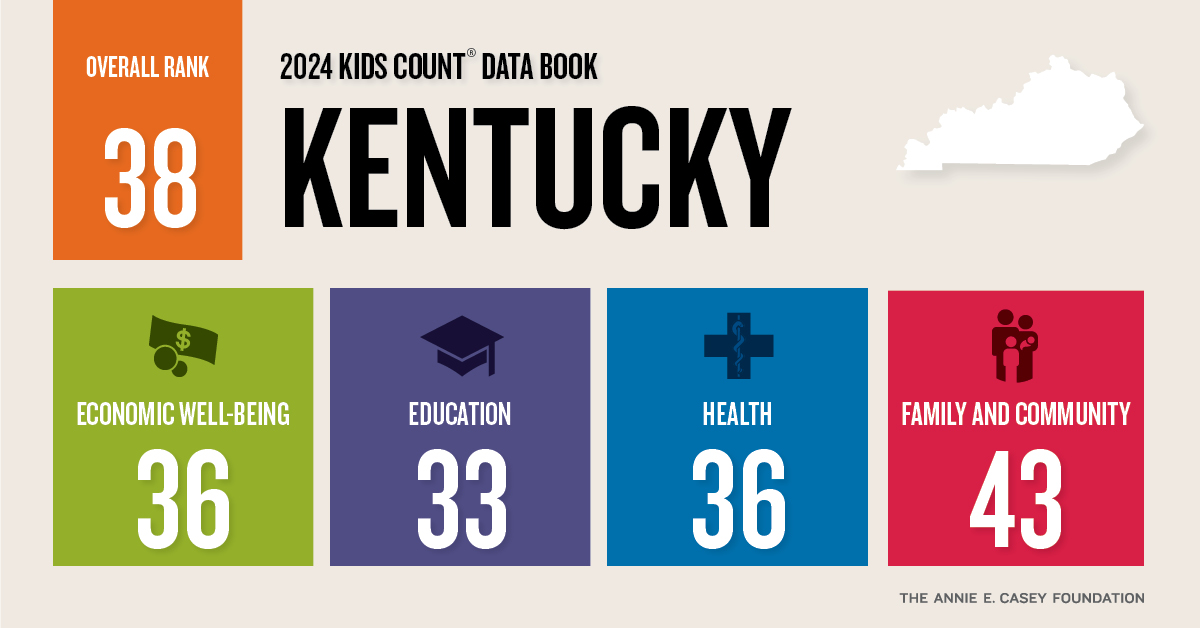
 LOUISVILLE, KY — Kentucky ranks 38th in child well-being, according to the 2024 KIDS COUNT® Data Book, a 50-state report developed by the Annie E. Casey Foundation analyzing how kids are faring in post-pandemic America. With a focus on challenges facing children’s educational outcomes, the data show Kentucky must do more to prepare children to learn so they are ready to earn when they reach adulthood.
While Kentucky has seen improvement in some indicators within the Economic Well-Being and the Family and Community Context domains, the Data Book outlines where the Commonwealth is falling more behind in several Education and Health indicators. In fact, in each domain of child well-being, Kentucky ranks within the bottom 10 of states for at least one data indicator, including percent of children in poverty, percent of 8th graders proficient in math, percent of youth who are overweight or obese, and the teen birth rate. Challenging factors, from poverty to physical and mental health, trauma, and others, impact a student’s ability to enter a classroom free from distractions and ready to learn.
“To meet educational milestones, kids of all ages must have what they need to learn – from enough food and sleep, to a safe way to get to school, to supports such as tutoring and mental health services. And they must be in schools where there is a qualified and well-supported teacher in every classroom,” said Dr. Terry Brooks, executive director of Kentucky Youth Advocates. “To be clear, kids are more than their test scores – but these scores give us the tools to understand the realities of our classrooms and a roadmap around imaginative reforms and targeted interventions. Innovation in classroom rhythms, school culture, and community collaboratives are key to ensuring children meet their milestones, as is recruiting and retaining a strong K-12 and early childhood education workforce.”
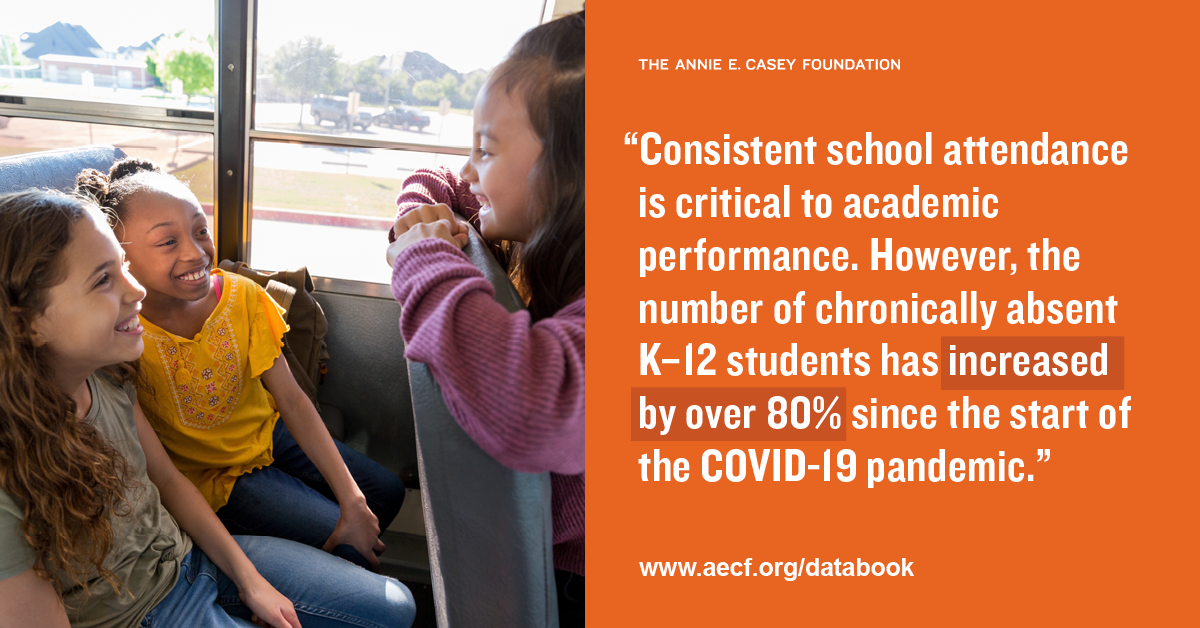
In its 35th year of publication, the KIDS COUNT® Data Book focuses on students’ lack of basic reading and math skills, a problem decades in the making but brought to light by the focus on learning loss during the COVID-19 pandemic. Unprecedented drops in learning from 2019 to 2022 amounted to decades of lost progress. Chronic absence has sharply increased, particularly among children living in poverty who struggle to consistently return to their regular school day routines.
The Data Book outlines key findings in the most recent educational outcomes for Kentucky:
- 69% of 4th graders scored below proficient in reading in 2022
- 79% of 8th graders scored below proficient in math in 2022
- 10% of high school students did not graduate on time in 2020-21
- 25% of children were chronically absent in 2021-22
Moreover, the state data masks disparities that affect students of color, kids in immigrant families, and children from low-income families. Kentucky data indicates that in 2022, 85% of Black students and 78% of Latino students were not at 4th grade reading proficiency, and just 1% of English-language learners were at or above 8th grade math proficiency.
The Casey Foundation report contends that the pandemic is not the sole cause of lower test scores – educators, researchers, policymakers, and employers who track students’ academic readiness have been ringing alarm bells for a long time. This lack of readiness will result in major harm to the economy and to our youth as they join the workforce, especially as students who don’t advance beyond lower levels of math are more likely to be unemployed after high school.
Kentucky’s elected officials and education leaders are taking steps already to address this growing crisis in student success. For example, a majority of Kentucky’s school districts have utilized their share of the critical federal Elementary and Secondary School Emergency Relief (ESSER) pandemic funding to help boost achievement. School districts are developing and implementing Trauma-Informed Plans as part of the School Safety & Resiliency Act of 2019 and subsequent state legislation. Additionally, the 2024 Kentucky General Assembly increased investment in the SEEK per pupil allocation, passed HB 377 to strengthen the student-to-teacher workforce pipeline, and funded the Summer EBT program to address student hunger while schools are not in session.
“There was a day when public education was the common ground for our Commonwealth. Elected officials, business and faith community leaders, and backyard neighbors came together – and the result? In the early nineties, Kentucky schools were the envy of the nation. We need to re-claim that legacy. We need to move from where we are – when seemingly public education is the most politized and divisive policy issue in Frankfort – and reclaim the ethos of Kentuckians joining together when it comes to K-12 classrooms,” added Brooks. “That kind of common ground agenda is essential for our children and just as critical in building a strong workforce and economy for the future. That means resources for sure, but it also means engagement by us all and a fundamental restructuring of how we do ‘school’ in Kentucky.”
Kentucky Youth Advocates joins the Casey Foundation to recommend the following:
- To get kids back on track, we must make sure they arrive in the classroom ready to learn by ensuring access to low- or no-cost meals, a reliable internet connection, a place to study, and time with friends, teachers, and counselors. With the federal Affordable Connectivity Program expiration approaching, Congress must act to reallocate funding so families can afford to stay connected.
- Deepen investments in school wrap around services to support student success and family connection. Family Resource and Youth Service Centers, tutoring programs, mental health services, nutrition programming, afterschool care, and other services support young learners and encourage parent engagement, which leads to better outcomes for kids.
- Address chronic absence, so more students return to learn. Lawmakers should embrace positive approaches rather than criminalizing students or parents due to attendance challenges, because they may not understand the consequences of even a few days missed.
- Expand access to intensive tutoring for students who are behind in their classes and missing academic milestones. Research has shown the most effective tutoring is in person, high dosage and tied directly to the school.
- Utilize all of the allocated pandemic relief funding to prioritize the social, emotional, academic, and physical well-being of students. As long as ESSER funds are obligated by the September 30 deadline, states should have two more full years to spend them.

###
RELEASE INFORMATION
The 2024 KIDS COUNT® Data Book is available at www.aecf.org. Additional information is available at www.aecf.org/databook. Journalists interested in creating maps, graphs and rankings in stories about the Data Book can use the KIDS COUNT Data Center at datacenter.aecf.org.
ABOUT THE ANNIE E. CASEY FOUNDATION
The Annie E. Casey Foundation creates a brighter future for the nation’s young people by developing solutions to strengthen families, build paths to economic opportunity and transform struggling communities into safer and healthier places to live, work and grow. For more information, visit www.aecf.org. KIDS COUNT® is a registered trademark of the Annie E. Casey Foundation.
ABOUT KENTUCKY YOUTH ADVOCATES
Kentucky Youth Advocates believes all children deserve to be safe, healthy, and secure. As THE independent voice for Kentucky’s children, we work to ensure policymakers create investments and policies that are good for children. Learn more at www.kyyouth.org.




[…] annual national KIDS COUNT Data Book includes more data into which to dive than column inches allow. But an overview of the report […]
[…] annual national KIDS COUNT Data Book includes more data into which to dive than column inches allow. But an overview of the report […]
[…] annual national KIDS COUNT Data Book includes more data into which to dive than column inches allow. But an overview of the report […]