
 When the Fostering Youth Transitions report was released earlier this year, True Up Kentucky and Journey to Success Kentucky lifted up the data trends that could be celebrated as progress, as well as those that highlighted the need for continued advocacy for policies and practices that improve the experiences for Kentucky’s transition-age youth.
In Kentucky, emerging trends made clear that advocates must rally to:
- Address the overrepresentation of youth of color in the child welfare system. In Kentucky, Black youth make up 10% of the general population and individuals identifying as having more than one race make up just 4%. However, 12% of Kentucky’s foster care population is Black and 7% identify as having more than one race. Additionally, 46% of Black youth and 50% of youth with more than one race experienced four or more foster care placements during their time in foster care, compared to 35% of White youth.
- Address the high rates of foster care cases attributed to child behavior problems by focusing on strengthening families and communities to reduce the need for child removals. In Kentucky, 46% of young people ages 14–21 entered foster care for child behavior problems, compared to 30% nationally.
- Better equip and staff child welfare agencies to promote permanence and prioritize supported kinship arrangements for older youth. Between 2006 and 2021 in Kentucky, placement in family-based settings and kinship care increased (to 59% and 11%, respectively) while group and institutional placement has decreased (to 21%). However, as that is an area of progress, the Commonwealth sees half of all young people aged 16 years and older exiting foster care in Kentucky by aging out, exposing them to risks including homelessness and economic instability.
- Improve extended foster care and delivery of transition services so young people receive what they need to thrive in adulthood, including stable housing, postsecondary education, and employment. Only 62% of Kentucky’s foster care population received a transitional service intended to prepare them to thrive when they leave foster care at any point between ages 14-21.
- Address barriers that prevent young people with foster care histories from securing stable housing, employment, and education in adulthood. In 2021, for 21-year-olds who have experienced foster care in Kentucky, 63% reported having stable housing, 64% reported secure employment, and just 16% reported postsecondary enrollment. There is progress in the outcomes for these young adults with decreases in incarceration and in becoming young parents.
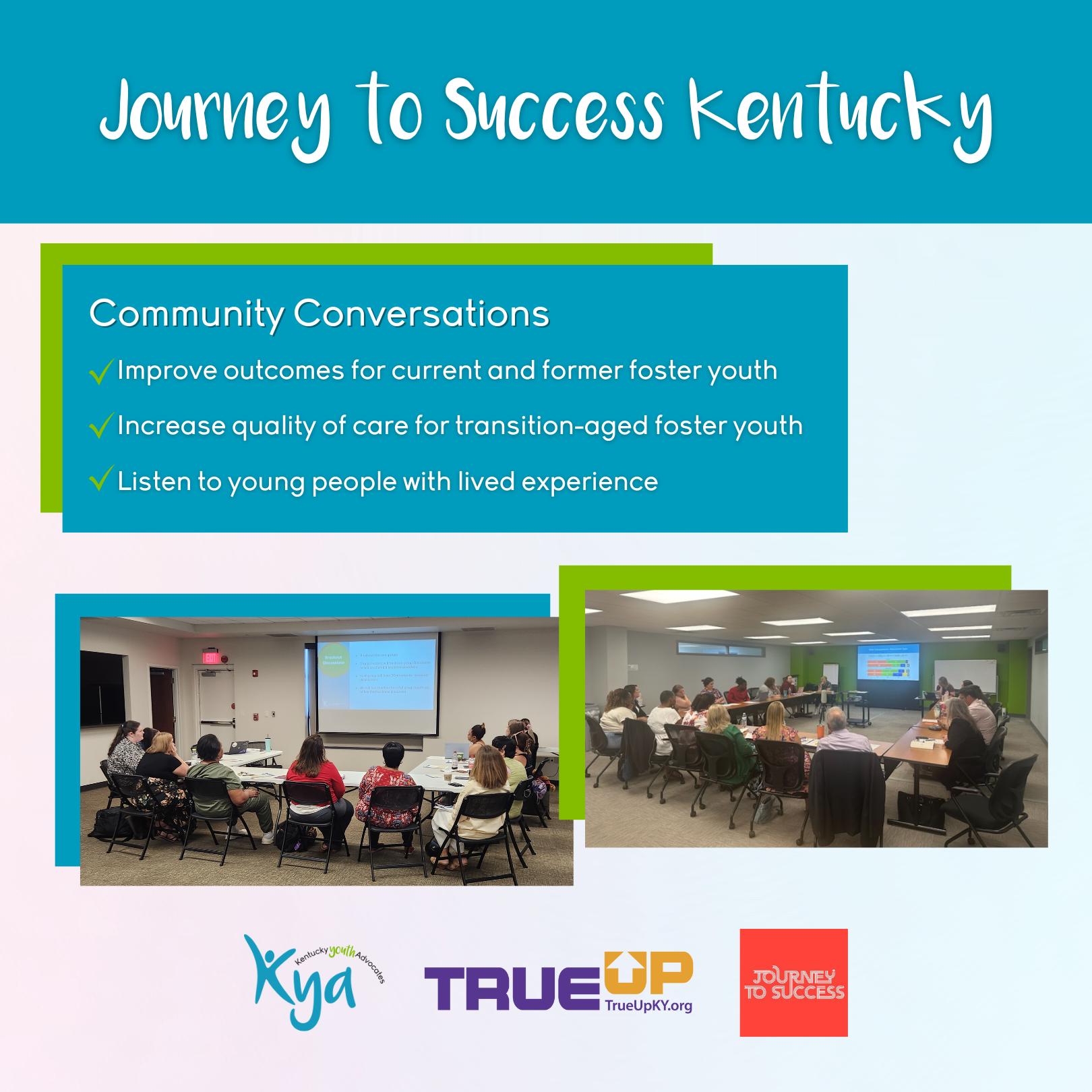 Throughout the Fall, the Journey to Success Kentucky team hosted a number of community conversations with a variety of child welfare stakeholders and foster alumni across the state to present the data and engage in fruitful discussions of action items needed at the program and policy level to increase quality of care for transition-aged foster youth in our state. Themes that emerged from these conversations included:
- Moving upstream to prevent families and children from ever becoming engaged in the child welfare system. Family preservation programs that provide concrete and financial support to caregivers, as well as improved access to behavioral health services for families and youth are areas of interest for advocates at the table.
- Improving concrete and financial support for kinship and fictive kin caregivers, when family preservation is not the best option. This can provide a more stable, permanent placement for young people while in the system and reduce trauma experienced through removals.
- Listening to young people with lived experience in the child welfare system to help shape transitional services that will appeal to and be used by them.
- Improving access to mental and behavioral health supports to transition-age youth, including addressing the lack of providers and extending healthcare coverage past age 26.
- Increasing investments for transitional services so that Kentucky communities can provide more services that meet the needs of young people with a foster care experience.
Later this month, the Journey to Success Kentucky team will travel to Washington D.C. to take part in the Journey to Success Week of Action on Chafee (December 11th-15th), where the team will meet with members of Congress, educate them on youth outcomes in Kentucky, and ask for their support in improving outcomes for youth by strengthening the federal Chafee Program.
Specifically, Journey to Success Kentucky is asking Congress to:
- Increase Chafee program funding by at least $100 million per year
- Improve communications to ensure that all eligible youth are aware of available services.
- Expand eligibility so young people up to age 26 may access Chafee services.
- Prioritize family connections to eliminate “aging out” alone as an acceptable outcome.
- Increase and update service offerings by soliciting feedback from youth as programs are implemented.
Learn more about the Journey to Success campaign and its efforts to reform the Chafee Foster Care Program.



Leave A Comment