
Kentucky kids need healthy environments to learn, play, and grow, free from the harmful effects of nicotine products like e-cigarettes and vapes. Unfortunately, Kentucky kids continue to get their hands on addictive nicotine products – with many buying them directly from a gas station, convenience store, or other retailer. Earlier this month, Kentucky young people and a Kentucky pediatrician joined state Senator Jimmy Higdon to make the case to the Interim Joint Committee on Licensing, Occupations, & Administrative Regulations for Kentucky to implement a strong tobacco retail license program to keep these products out of the hands of kids.
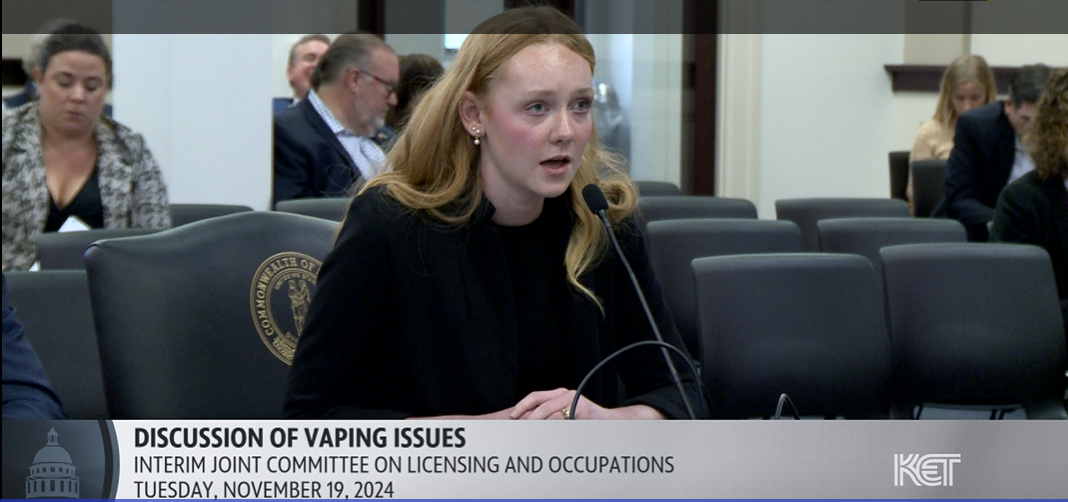
Testimony from Philena Ash:
My name is Philena Ash, and I am a resident of Shepherdsville in Bullitt County and a senior at Bullitt Central High School. As an athlete, I was taught from a young age to stay away from anything that could harm my health or performance, including vaping.
Many of my very talented friends started vaping in middle school and into high school, and over time, I not only watched them increase their use but saw their health and athletic performance decline. These are kids who had a real chance at college scholarships, but now they may never have that opportunity.
Nicotine is dangerous. It is disappointing to see young people, my friends, lose their future because of nicotine dependence, and it is even more disappointing to see that the Tobacco 21 law in our state that was passed to help protect them is not being effectively enforced.
This is why I’m asking for your help today. In my community, youth can go to almost any gas station or convenience store and purchase a vape without having their IDs checked. Right now, it is too easy for kids to buy these products, and it is being reflected in the number of my peers who are using them.
We need your support and stronger action on this issue.
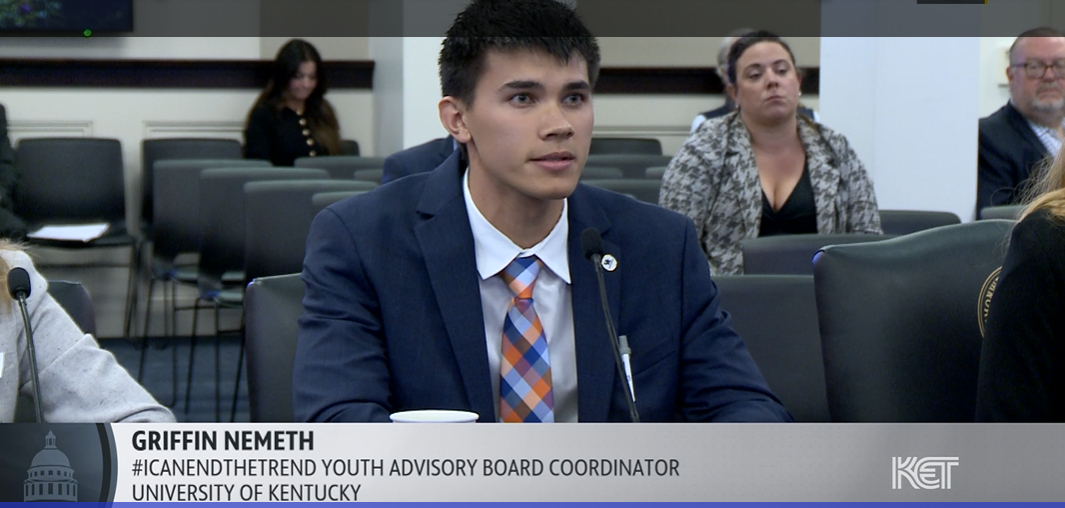
Testimony from Griffin Nemeth:
My name is Griffin Nemeth, and I am the youth advisory board coordinator of #iCANendthetrend, a peer-to-peer tobacco prevention and education program at the University of Kentucky.
With recent data, we know that there has been a slight improvement in the usage rates of e-cigarettes among youth, both in our state and nationally. However, 1 in 10 Kentucky middle school students and nearly 1 in 5 Kentucky high school students still report current use of e-cigarettes. These data tell us that nicotine dependence is still very prevalent among youth today, especially among our younger middle school students, whose usage rate was more stagnant nationally.
In the 2024 session, House Bill 11 was introduced with the goal of addressing the youth e-cigarette use crisis. As passed and even if it is enforced, it fails to include the three constitutive components of Tobacco 21 enforcement:
- Licensing of all retailers of any tobacco or nicotine product to know who is selling;
- Performing annual compliance checks to ensure that the minimum legal sales age is being upheld, including performing follow-up checks for violations; and
- Implementing enforceable, escalating civil penalties for retailers who commit violations, including up to license suspension and revocation.
These three elements work in other states – the data shows it – and Kentucky is one of only about ten which does not have a similar Tobacco 21 enforcement structure. Without proper licensure of retailers, from whom 12% of Kentucky high schoolers report directly buying their nicotine products compared to 7.3% nationally, we are almost guaranteeing that products will remain on the shelves and be made available to kids.
To date, the FDA has authorized only 34 e-cigarette products, with only one of the three authorized brands appearing in the top 5 most used e-cigarette brands among youth in 2024. Those with flashy colors, fun flavors, games, and even in the shape of cartoon characters are clearly targeted at youth and are not legal, yet they remain on the market. Zyn and other alternative nicotine products advertised as “safer” forms of nicotine, of which we are seeing an increase in use among youth, are neither safe nor authorized. Yet, I have no doubt that we will see the same boom that we saw with cigarettes and currently see with e-cigarettes.
Our ask is simple. We are before you again today asking you to pass legislation to effectively enforce the law against underage sales and help mitigate the effects of industry manipulation of our youth.
We must act further, and we must act now if we are to see meaningful change in nicotine product use among youth. Retail licensure of all tobacco and nicotine products with a retailer database, annual compliance checks, and strong, enforceable penalties for violations is a proven approach to curbing this epidemic. There is a reason that 40 of 50 states have adopted some form of licensure, and if we’re being honest, Kentucky is one that needs it the most.
I would like to make it a point in saying that licensure is not anti-business. The only businesses who will be harmed by licensure are those acting criminally and selling unauthorized products to underage youth.
Please, let’s finally put an end to this and pass serious policy to enforce the minimum legal sales age. We appreciate the past and present support of the legislature and hope that you similarly see licensure as an opportunity to protect public health.
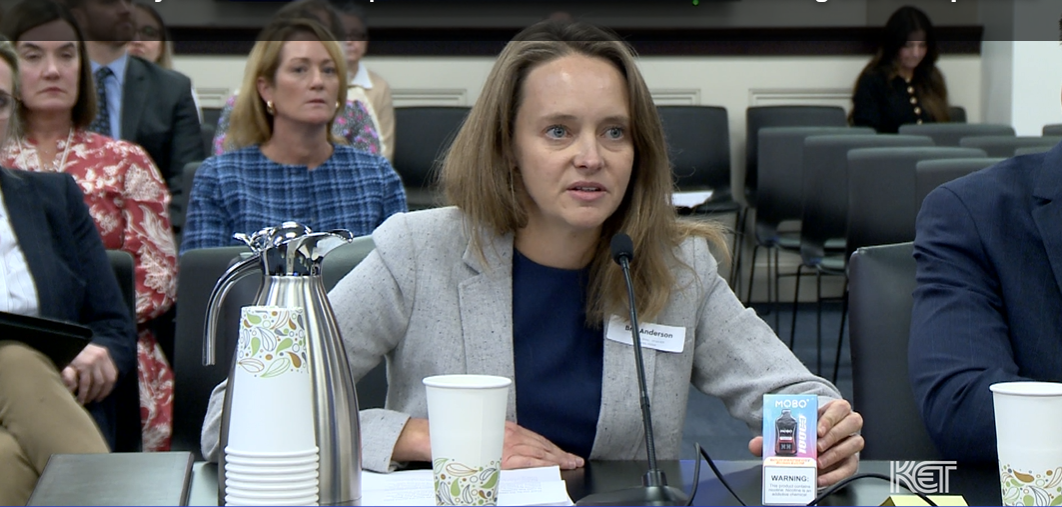
Testimony from Dr. Brit Anderson:
My name is Brit Anderson, and I am a pediatric emergency medicine physician in Louisville and President-elect of the Kentucky Chapter of the American Academy of Pediatrics. My testimony is based on my personal and professional expertise and does not represent any official position of the University of Louisville or Norton Healthcare.
There are many great things about my job, but I didn’t decide to become a pediatrician because of the cute kids or the snuggly babies — though that helps! I noticed that people who interact with kids can do seemingly small things that have an outsize impact down the road. Like a boat adjusting course just slightly early in a voyage can completely change the destination.
Or like a child in 7th grade hanging out with some friends, who then decides to walk into a retail store to try to buy an e-cigarette. Does the retailer sell it to her or decline because she’s legally too young to purchase one? Such a small, momentary interaction is the difference between a child that I see in the emergency department, wheezing and sneaking her vape pen out of her pocket when she thinks I’m not looking because she’s already addicted and can’t make it through the visit without it, and a child who is denied, grumbles a little, and walks out of the door empty-handed to find something else to do with her friends.
That’s it. A small decision with big implications now and potentially huge consequences later.
We know that nicotine is highly addictive, especially for young people, and that many young people who use e-cigarettes go on to smoke traditional cigarettes. Nicotine has detrimental effects on a developing brain including diminished impulse control, learning difficulties, problems with attention, even mood disorders like anxiety and depression. E-cigarette use is also associated with increased risk of asthma, COPD, and cardiovascular disease. And despite all this, we are still learning about long-term consequences.
As a doctor, it is my job to care for sick kids and talk with families about their health decisions, not just for today but for the entire lifetime. You have the awesome privilege and responsibility of enacting policy. Tobacco 21 enforcement can change the health trajectory of real children in our state.
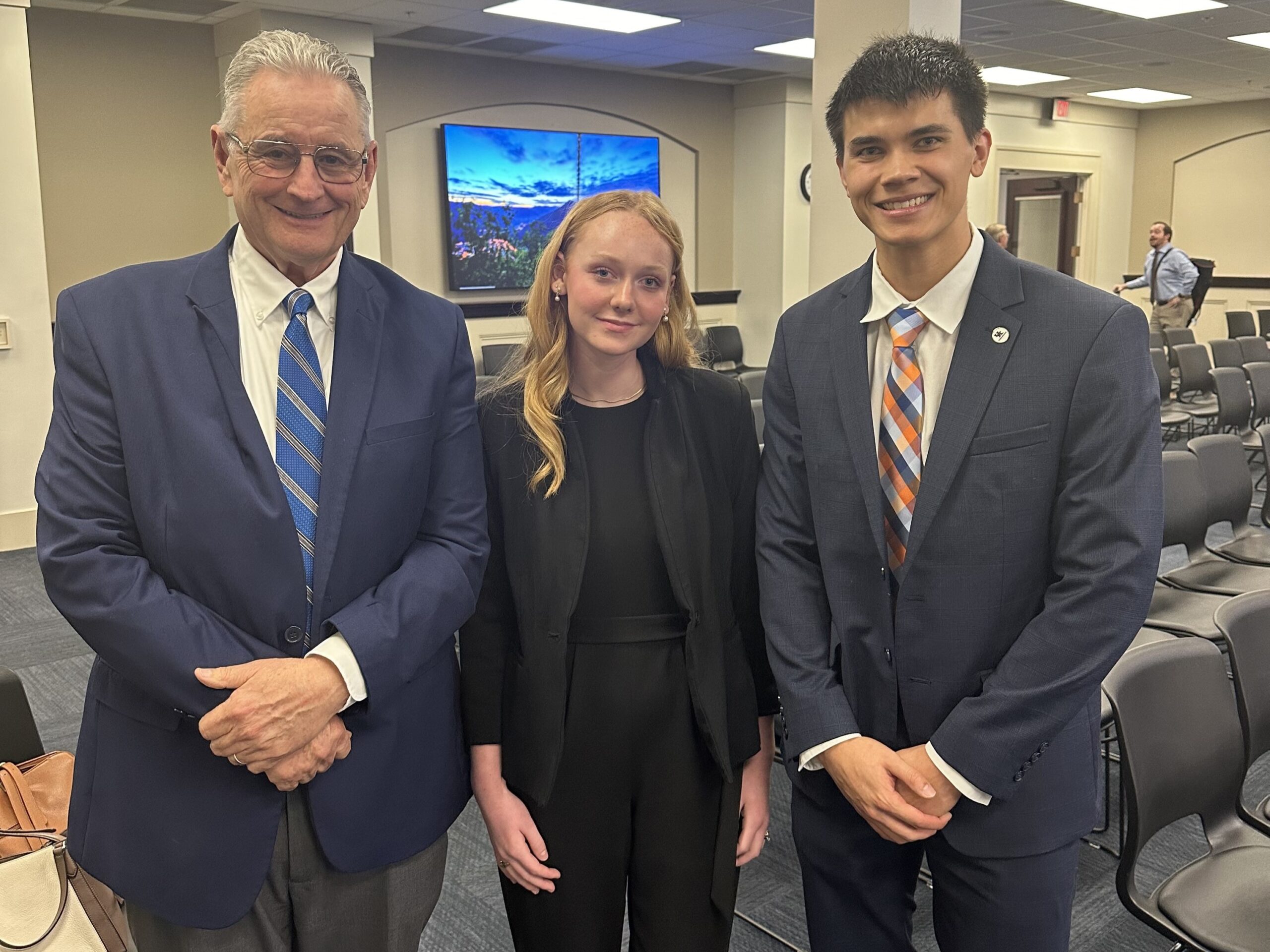
State Senator Higdon with Philena Ash and Griffin Nemeth
Watch the November 19th testimony (beginning at 40:30) here and check out more about the issue from KET and the Kentucky Lantern.
Are you passionate about youth vaping prevention or have a story to share? Contact your state Senator and Representative to share and urge them to take action during the 2025 state legislative session!




Leave A Comment