

What are you most proud of in your 20-year tenure at KYA?
When I came to KYA in 2005, I was struck and actually angered that the aspiration of the broader child advocacy community was simply to make a lot of noise. What’s that Texas phrase?” “All hat. No cattle.” Have a rally. Hold a press conference. Wave some signs.
And …
literally, no one ever talked about winning. Instead, candidly, you heard all kinds of excuses about why all those other causes were racking up policy wins and kid issues just couldn’t cross the finish line.
That narrative has changed. We expect lawmakers to prioritize kids and in so many ways that – in fact — they have done through dozens of good pieces of legislation. We expect whomever lives in the Governor’s Mansion to deliver. And in an especially positive development, we see Constitutional officers like AG Coleman and Auditor Ball now mounting initiatives that win for kids.
KYA now holds itself accountable for delivering results and not just rhetoric. And that “Win, Baby, win!” mentality? It is the defining difference for KYA from 2005 until today.
.
What has surprised you most about child advocacy?
There are two surprises. One is a positive and one is not.
The positive emanates from the power of unlikely allies. It’s one thing for folks in the “kid business” to stand up for our boys and girls. And those voices are important, carrying both credibility and passion.
But on so many issues, the “knockout” punch on a piece of legislation was delivered by a pastor or a business leader or a grandma. And I have been especially animated by the power of voice carried by young people themselves. In some cases, those unlikely allies carried a high level of influence already and had become convicted of a need or been caught by a crisis. In other cases, that unlikely ally – and especially in the case of the youth – came like lightning out of the blue and was driven by an individual having been personally touched by a relevant experience. Unlikely voices “punch above their weight” and are a growing force for Kentucky’s kids.
The disappointing surprise is the impact that the national trend towards political bifurcation has perpetrated on the kid advocacy space. It was not that long ago that K-12 education, early childhood education, juvenile justice, child welfare and a spate of other kid sectors featured the highest levels of collaboration in Frankfort. Rural and urban lawmakers. Conservative and liberal voices. Disparate voices fought about a range of other issues … often quite appropriately for the vibrancy of our democracy … but when it came to kids, the Commonwealth’s leaders were bound by the common good. There has been an alarming sea change in the last few years in which issues that should have no ideological foundation have become “red meat” both for the left and for the right. I fear that this tsunami that politicizes every kid agenda item is not subsiding – and I rather desperately hope I am wrong.
What’s one thing you’ve learned along the way that stood out to you?
A respected colleague recently reminded me that about a decade ago, one of KYA’s “learning themes” was about the “ripple effect.” You get it – throw a rock in that pond and watch the ripples spread and spread. Ideas about kid policy are like that too. A data point that shocks the system. A tragic headline grabbing the attention of the news media. A political leader who “catches religion” on some aspect of “the state of our kids.” And suddenly the ripple begins. And spreads. And spreads more. And grows ever stronger.
There are two challenges with ripples.
First, you have to throw a lot of rocks – or ideas – out there because every one simply does not have a causative effect. That takes imagination on a large scale.
Secondly, a ripple takes a long time to reach its full impact. That is true for that rock in the lake or an idea to come to life in a piece of legislation. And that takes persistence.
Ah but the joy of an effective ripple! A nascent idea is floated in Year One. That idea gains traction in Year Two. That traction leads to action in Year Three. And by Year Four? That ripple is touching the lives of our children in real and pervasive ways.
Ripples are as real as they are powerful! And advocates need both the imagination and persistence to keep “throwing those rocks.”
As KYA’s approaches its 50th anniversary, what’s your hope for the KYA legacy?
The answer I want to give is longer than War and Peace. I could talk about the importance of financial sustainability in a tough fiscal environment for every nonprofit. I could talk about the track record KYA has established of a Board and a staff as remarkable for its imagination as for its initiative; as distinguished by its courage as for its concern; and, as driven by its heart as for its head. I am proud that KYA reacts to crises in real time but also is committed to looking upstream for long-term solutions. And I hope those cornerstones of KYA are our hallmarks when the 75th Anniversary is celebrated.
But let me lay out a more focused and immediate hope I have for the specific anniversary year. And what a legacy it would be!
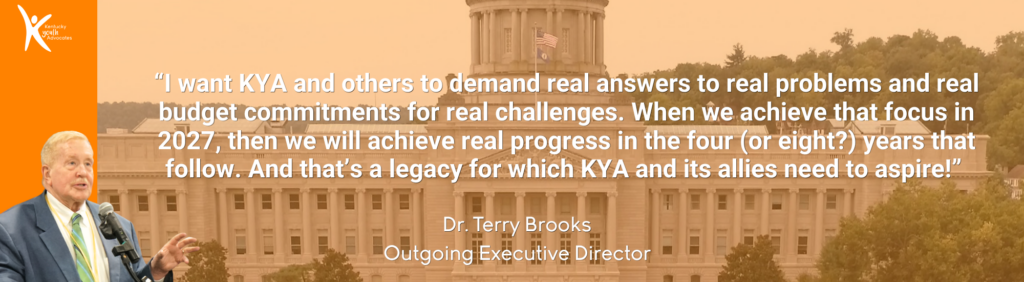
I hope that 2027 is the year when kids dominate the gubernatorial campaign. Not state issues like battery plants, bourbon, marijuana. Not national issues that may gin up the respective electoral bases but carry no import for the governance of the Commonwealth. Instead, I hope that KYA and its allies will demand both candidates to “talk turkey” about our boys and girls. I want KYA and others to demand real answers to real problems and real budget commitments for real challenges. When we achieve that focus in 2027, then we will achieve real progress in the four (or eight?) years that follow. And that’s a legacy for which KYA and its allies need to aspire!
We all know Terry Brooks loves a good metaphor. What’s your parting metaphor or wisdom when it comes to Kentucky kids?
Well, if there is anything I love more than a metaphor, it is football.
And in the game of football, you see two kinds of quarterbacks. The first QB genre receives a play call from the bench, and he runs that play with absolute fidelity. It doesn’t matter how the defense lines up. It doesn’t matter if there’s a better play he has in his hip pocket. His goal is simply to run what has been called and hope for the best.
And then you have the QB who can audible from the line of scrimmage. Now that kind of QB certainly has a playbook. He clearly has some notions as he approaches the line of scrimmage. But he pauses – experts say for 3.7 seconds – and scans the defense, assesses what has been working and maybe – just maybe – trusts some instinctual wisdom – and then he calls the play and takes a chance.
For our children to win in the policy arena, advocates had better be quarterbacks who can audible. Conditions change. National events and state trends inevitably invade public dialogue. Leaders – at every level and in every sector – are transient. And the core issues five years from now are like predicting the weather today for Derby Day 2031.
That means that champions for kids have to be fluid and agile. Neither the strategies they employ nor the issues they tackle are fixed. Neither the leaders on whom they depend nor the partners on whom they can count are stationery.
The best quarterbacks at audibling see:
- the entire field,
- incorporate relevant knowledge,
- are confident enough to take a risk
- and … don’t miss this … trust their gut.
Kid advocates can learn a play or two by emulating that formula!



Leave A Comment