
The following reflects Kentucky Youth Advocates’ presentation to the Commission on Race & Access to Opportunity and Juvenile Justice Oversight Council on June 20, 2023 – watch the testimony and view the presentation.
 Over the last several years, the Kentucky General Assembly, Administrative Office of the Courts and their Court Designated Workers program, and critical stakeholders have made tremendous progress in reforming the juvenile justice system and the way we respond to kids who get in trouble. Since the implementation of Senate Bill 200 of 2014, there has been a steady decline in the total number of kids entering the system.
However, there are areas where racial disparities still persist, with Black kids accounting for anywhere between two and four times their representation in the population the deeper into the system they go.
 In 2022, White kids made up 81% of the total youth population, Black kids made up 11%, Hispanic kids made up 6%, and 2% were multiracial. When looking at all of the complaints filed against youth:
- Black kids made up 22%,
- multiracial kids accounted for 8%,
- White kids were 63%, and
- Hispanic kids made up 6%.
Another area where disparities have persisted within the juvenile justice system is in the percentage of complaints that result in detention at intake. Detention at intake refers to kids who have been arrested and an on-call Judge determined they needed to remain in detention pending their initial court hearing. Among this population, White kids accounted for 46% of all detained complaints, multi-racial kids at 9%, and Black kids at 39%.
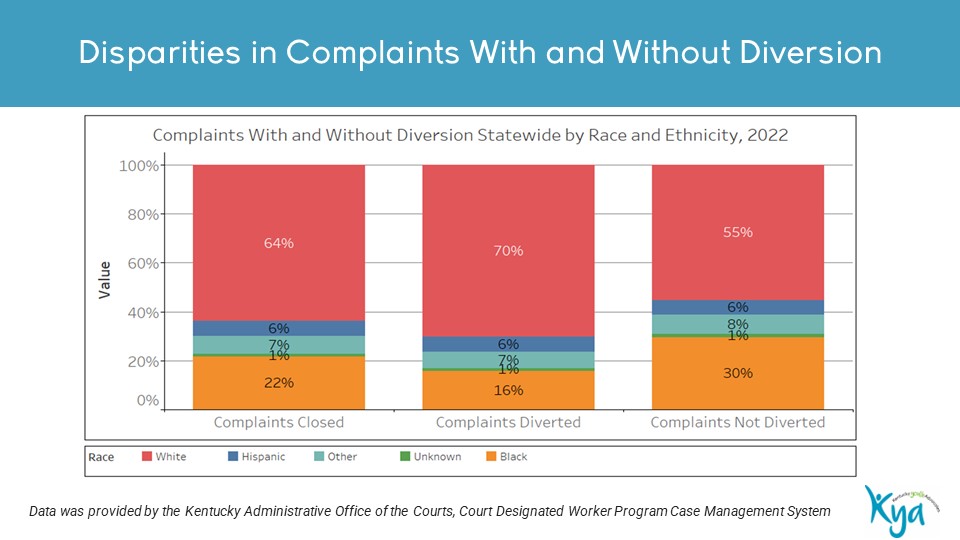 When looking at complaints that are diverted – meaning, kids who are held accountable through community-based interventions instead of a formal court process – there is an overrepresentation of Black kids whose cases are not diverted. In 2022, Black kids accounted for only 16% of all complaints diverted and 30% of those that were not diverted, compared to 70% for White kids whose complaints were diverted and 55% whose complaints were not diverted.
The deepest point of the juvenile justice system is having a case referred to adult court. This population is known as youthful offenders and it is where we see the greatest racial disparities. Despite making up only 11% of the total youth population, Black kids make up 52% of all the youthful offender referrals to adult court statewide. When you look at regional data for counties like Jefferson or Fayette, the disparities are even larger. Multiracial kids make up 8% of youthful offender referrals, Hispanic kids account for 9%, and White kids make up 31% of that population.
At the state level, stakeholders have taken proactive steps to address the racial disparities at different decision points in the juvenile justice system. Through policy changes – like changing the way families are notified about diversion opportunities – implicit bias training for court personnel, and working with local judges and prosecutors to reduce the use of overrides that kept kids from accessing diversion programs, Kentucky has made significant progress. And by expanding our use of diversion, we can hold kids accountable and improve their long-term outcomes.
Study after study has shown the positive effects of diversion:
- Lower recidivism rates. Kids whose cases are diverted – to counseling, treatment, or other programming – are less likely to be re-arrested or incarcerated in the future and they’re less likely to engage in violent behavior or associate with delinquent peers than kids who go through a formal court process.
- Improved educational outcomes. Kids whose cases are diverted are more likely to complete high school, have higher rates of college attendance, and have higher earned income as adults.
- Prioritizes public safety. Reserving detention for kids who pose a greater risk to public safety means more resources and greater staff capacity at each decision point to work with a population with higher needs.
- Gets to the root of the problem. By using a community-based approach, kids and their families will have responses or interventions that are sustainable and tailored to meet their unique needs.
By continuing to build on the exceptional work that The Administrative Office of the Courts and the General Assembly have done, we will continue to see greater opportunities to keep children out of the juvenile justice system and better outcomes for the kids who enter it.


Leave A Comment